
The reason most SaaS SEO programs plateau isn’t effort, it’s a category error. SEO teams treat SaaS like a media site and measure success in pageviews, or they treat it like e-commerce and optimize for conversion on pages that buyers use for education. Neither model fits.
SaaS sits at an uncomfortable intersection: the buying journey is long (often 3 to 9 months for mid-market), the decision involves multiple stakeholders, and the same query “project management software” can be typed by someone who just Googled it out of curiosity and someone who is a week away from signing a $150K contract. You have no way to know which without understanding intent beyond the keyword itself.
What further complicates SaaS SEO is that the search universe for most SaaS categories is thin. A company selling revenue forecasting software to CFOs at mid-market companies might have a true addressable organic audience of 40,000 people per month across all relevant keywords. You are not chasing mass traffic. You are building a precision system to reach a specific type of buyer at the exact moment their problem becomes urgent.
That precision is what makes SaaS SEO so high-leverage when done correctly and so frustrating when done generically. Companies that understand this build content programs that generate $4–6 in pipeline for every $1 invested in SEO over a 24-month horizon. Companies that treat it as a blogging exercise generate traffic reports and wonder why leads never show up.
The 68% of B2B buyers who complete most of their evaluation research independently before speaking to a sales rep aren’t searching randomly; they are following specific information paths. Your SaaS SEO strategy is either architecting those paths toward your product, or it’s watching someone else do it.
Building the Foundation Before You Publish a Single Word
Every failed SaaS SEO program I’ve seen had one thing in common: they started with content. They opened a keyword tool, found some decent-volume terms, assigned them to writers, and hit publish. Six months later, nothing ranked. Twelve months later, they concluded “SEO doesn’t work for us.”
SEO did work. The infrastructure wasn’t there to support it.
Before you publish a single article, three things must be true.
Your technical foundation must not be working against you. This sounds obvious until you see how often it isn’t. SaaS products create unique technical SEO landmines:
- Subdomains used for the product app that dilute authority from the marketing site,
- JavaScript-heavy frontends where Googlebot gets a blank page on crawl, dynamically generated content behind login walls that eats crawl budget, and staging environments accidentally indexed because someone forgot a robots.txt directive. None of these are exciting to fix.
- All of them silently suppress rankings for months before anyone notices.
- Run a full crawl audit, resolve canonicalization and indexation issues, and confirm that Google is actually rendering your pages the way you think it is before content investment scales.
Your attribution must work before you need it. The fastest way to lose executive support for an SEO program is to have meaningful organic traffic for 12 months without being able to say how much of it is converted to pipeline. Set up UTM parameters, confirm organic session attribution is flowing into your CRM, define what counts as an organic MQL, and build a dashboard that tracks organic-attributed pipeline from first touch. Do this at month one, not month nine.
Your keyword strategy must be derived from your ICP, not a keyword tool. Keyword tools tell you what people search. They don’t tell you which searchers have budget, authority, and urgency. Before touching volume data, go back to sales call recordings, support ticket language, lost deal notes, and customer interviews. The words your best customers used before they understood what they needed are your most valuable SEO signals. Keyword tools help you quantify the universe your customer data tells you where in that universe the real buyers live.
Keyword Strategy by Funnel Stage: Where Budget Actually Belongs
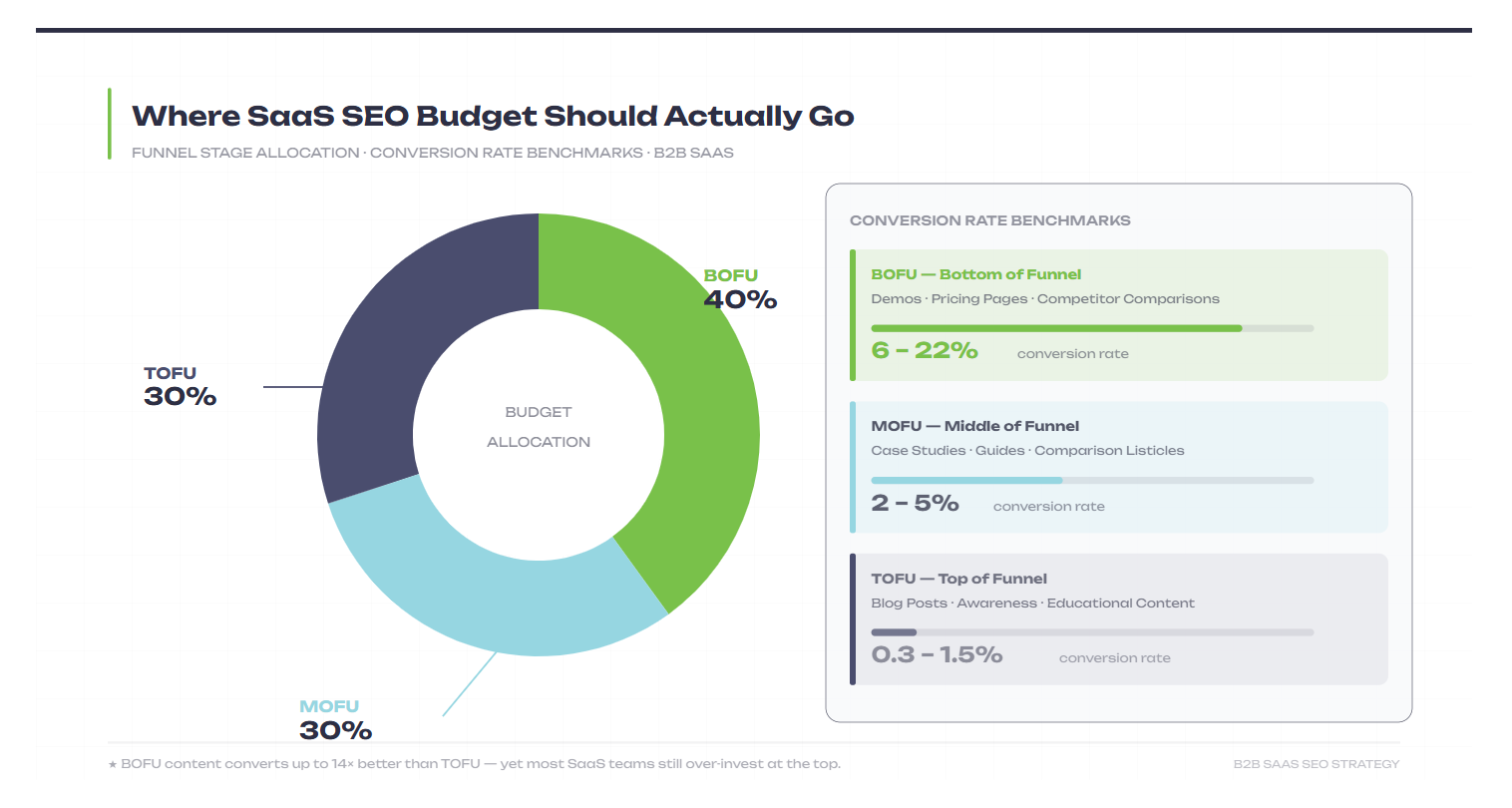
The actual conversion delta between a well-built competitor alternative page and a TOFU educational post is often 10:1. That does not mean ignore TOFU; it means be deliberate about why you’re investing there.
Here is the strategic reality most SaaS content teams haven’t internalized: 70% of their content investment goes to keywords that attract people who will never buy, and 10% goes to keywords that attract people who are ready to.
This isn’t a content quality problem. It’s a prioritization problem rooted in how SEO teams are evaluated. Traffic is easy to measure and fast to grow. Pipeline contribution is harder to measure and slower to prove. So teams default to volume, and volume lives at the top of the funnel.
The following framework is how a pipeline-oriented SaaS SEO strategy should actually be allocated:
TOFU content earns its place for two reasons that aren’t direct conversion: it builds topical authority that lifts the rankings of all your other pages, and it creates remarketing audiences and brand touchpoints that shorten later conversion cycles. But funding it at 70% of your content budget while BOFU pages sit un-built is one of the most common ways SaaS companies leave pipelines on the table.
The practical starting point: audit every competitor in your category and identify which “alternative” and “vs” keywords exist. These are buyer-intent terms with established search demand that your competitors have validated. Build high-quality, honest pages for all of them within the first 60 days of any serious SaaS SEO program.
Topical Authority Is Not a Content Calendar and Here’s the Difference
The term “topical authority” has been used so loosely that it’s become nearly meaningless. Let me be specific about what it actually is and what separates a content cluster that ranks from one that doesn’t.
Google’s systems evaluate whether a given website can be trusted as a comprehensive, expert source on a topic not just for a single query, but across the full semantic space of related queries. This means a site with 40 deeply interlinked, high-quality articles on a narrow topic will outrank a domain authority 80 site that has 3 articles touching the same topic.
The word “deeply” is doing heavy lifting in that sentence. Most content clusters fail because they’re topically adjacent but not semantically dense. If you sell HR software and you have a pillar on “employee onboarding” with five supporting posts you’ve started a cluster. But if all five supporting posts are 600-word summaries that don’t say anything the pillar doesn’t already cover, you have not built topical authority. You have published thin content that Google will sandbox indefinitely.
Real cluster architecture means:
- Each supporting article addresses a distinct subtopic that the pillar intentionally left shallow
- Supporting articles link to each other when genuinely relevant not as a mechanical exercise
- The pillar itself links out to supporting articles at the moment the topic they address becomes relevant in the text
- The cluster has internal depth: some supporting articles have their own sub-supporting pieces
The signal Google is responding to is: does this website understand this topic well enough that I would trust it to answer any question a user might have within this domain? The content that answers yes to that question ranks. Everything else competes on domain authority and link volume is a game with worse economics.
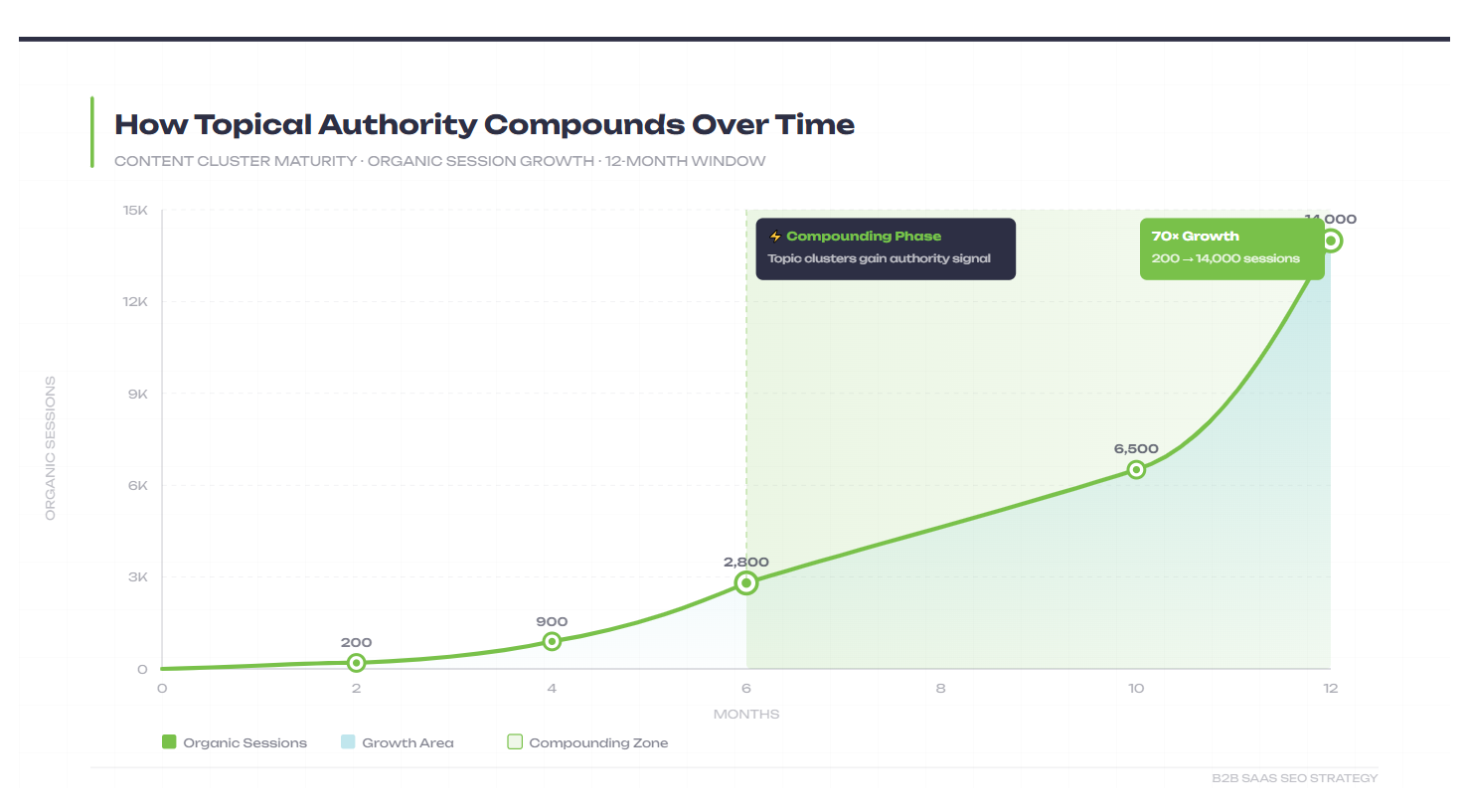
Insight: Topical authority doesn’t build linearly. The first 3-4 months see modest traction. Months 6–12 is where the compounding effect becomes visible and which is exactly when most teams lose patience and pivot.
Product-Led SEO vs. Editorial SEO: Choosing the Right Engine
These are not competing strategies. They are two different answers to the same question: how do we create pages that rank at scale?
Editorial SEO means you write and publish content through a content team. The ceiling is human bandwidth. The floor is quality control. It scales to roughly 15-25 high-quality pieces per month for most SaaS teams before quality degrades.
Product-led SEO means your product creates the pages. Zapier has over 50,000 indexed integration pages. Canva’s template library generates organic traffic that a content team of 500 could never replicate. G2’s review ecosystem is a product-led SEO machine built entirely on user-generated structured data. None of those pages were individually written.
The question for your SaaS company is: what does your product generate that users would independently search for?
If your product has an integration layer every tool you connect to is a rankable page. If your product generates output (reports, templates, documents, dashboards) those outputs are rankable if made public and structured correctly. If your product serves specific verticals or geographies, combination pages (“construction project management software in Texas”) are rankable at scale.
The constraint that kills most programmatic SEO programs is the temptation to launch pages that technically exist but add no value. A page that says “[Tool A] integrates with [Tool B]” with two sentences of description and no real content is thin content. Google has seen millions of them. They don’t rank anymore, and a large-scale rollout of thin programmatic pages can contaminate the authority of your entire domain.
The threshold for programmatic SEO pages: each page must answer a specific query completely. If it can’t, it doesn’t ship.
BOFU Content: The Asset Class SaaS Teams Consistently Underinvest In
If you’re running a SaaS company and you haven’t built a comprehensive competitor alternative page strategy, you are leaving a measurable amount of pipeline on the floor right now.
Here is why competitor alternative content works so well and why most teams underinvest in it: it feels uncomfortable. Writing a page called “[Competitor Name] Alternatives” requires you to acknowledge that buyers are evaluating your competitors, say something specific and honest about why those competitors fall short for a particular use case, and position your product directly against named alternatives. Marketing teams often resist this. Legal sometimes flags it. Leadership occasionally finds it “too aggressive.”
Meanwhile, that page — built correctly — converts at 6–14% of organic sessions to trials or demo requests, which is 5–10x the conversion rate of most editorial content. The buyer who lands on “[Competitor] Alternatives” is not browsing. They have made a decision to leave and are actively looking for somewhere to go.
The anatomy of a high-converting competitor alternative page:
- Lead with the use case where the competitor genuinely struggles — don’t lead with your own features
- Be specific about the limitation: “Limited reporting customization for teams above 50 users” beats “lacks advanced reporting”
- Present 3–4 alternatives including competitors — yes, include competitors. Pages that list only your product look like ads. Pages that provide genuine comparison data get trusted and linked to.
- Position your product for the specific buyer profile where you genuinely win
- Include social proof — quotes, case studies, G2 excerpts — that are specific to the transition from that competitor
The same architecture applies to head-to-head comparison pages and vertical use case pages. The common thread is specificity over self-promotion.
Programmatic SEO: Scale Without Spam
The line between programmatic SEO and content spam is thinner than most teams think, but the delta in outcome is enormous.
The SaaS programmatic SEO plays that consistently work:
Integration pages with depth. For every integration your product supports, build a page that explains specifically what data flows between the two tools, what workflows it enables, what problem it solves, and which type of user benefits most. This is not a two-sentence stub. It’s 600–900 words of genuinely useful content that happens to be templated. Zapier built one of the most successful organic growth programs in SaaS history on this exact play.
Comparison databases. If your category has 10+ tools, a structured comparison database with real, accurate data on pricing, features, integrations, and use cases is both a high-traffic organic asset and a trust-building resource. Maintain it. Outdated comparison data is a brand liability.
Template libraries. If your product helps users accomplish specific tasks, turn the 50 most common task frameworks into indexed, publicly accessible templates. Each template page targets the specific query someone types when they’re about to do that task. They land on your template. They realize it lives inside your product. Conversion happens organically.
Location and vertical modifier pages. “Accounting software for construction companies” or “HR software for healthcare practices” these modifier combinations have real search volume and dramatically lower competition than the head terms. Build them programmatically, differentiate with industry-specific content, and link them from the relevant pillar pages.
The non-negotiable requirement across all of these: structured data and canonical architecture must be correct from launch. A poorly canonicalized programmatic rollout can result in thousands of indexed near-duplicate pages that suppress your entire domain.
Link Building for SaaS: The Two Strategies That Actually Work
I have watched SaaS companies spend tens of thousands of dollars on link building tactics that produce referring domains without producing rankings. Let me save you the tuition.
Guest posting at scale stopped working as a primary link building lever around 2022. The links it produces are real but they’re low-signal — Google has become sophisticated at identifying link velocity patterns that come from outreach programs. You can still get value from guest posting on genuinely selective, high-authority publications where your target buyers read. But if your link building strategy is “publish 20 guest posts per month across any DA 30+ site,” you’re buying link volume, not authority.
Outreach-based link acquisition to random sites produces the same result: referring domain count goes up, rankings move modestly if at all, and the CAC for each link is unsustainable.
What actually works for SaaS link building:
Original research. Publish a piece of proprietary data that other writers in your industry need to cite. The SaaS benchmarks report that gets referenced in 80 blog posts over the following year. The state-of-the-industry survey that journalists quote. The data analysis from your product that reveals a pattern no one else could surface. This is high-effort to produce once and then earns links continuously for years. A well-distributed original research piece in a competitive SaaS category typically generates 15-20 referring domains within the first 90 days, from sites that would never respond to a cold outreach email.
Free tools embedded in your category. Build a free, genuinely useful tool that sits adjacent to your product category. A churn rate calculator for SaaS companies. A CAC payback period model. A pricing strategy estimator. These tools earn links because writers link to tools as resources. They earn traffic because people search for them directly. They convert because the people using them are exactly the buyers your product serves. The tool pays for its development cost in link value within 12 months in most SaaS categories.
The secondary strategies are digital PR, integration partner co-marketing, analyst mentions are real and worth pursuing, but they’re force multipliers on a strong content foundation, not substitutes for it.
SEO + Demand Generation: Why the Silos Are Killing Your Pipeline
Here is a scenario that plays out constantly in B2B SaaS companies: the SEO team reports 40,000 monthly organic sessions and 380 organic form fills. The demand gen team is running $80K/month in paid search and reporting 310 MQLs. Leadership sees two separate line items and compares them as if they’re parallel.
What they’re not seeing: 60% of the paid conversions had an organic touchpoint earlier in their journey. The SEO content created the category awareness and trust that made the paid click convert. The two channels aren’t parallel — they’re sequential. And when teams manage them in isolation, they make decisions that undermine both.
The integration points that matter most:
Let paid search validate organic investment decisions. Before committing to a 3,000-word piece of MOFU content targeting a mid-volume keyword, run paid against it for 30 days. If the landing page converts at 4%+ with paid traffic, the organic investment is validated. If it converts at 0.8%, you have a product-market messaging problem, not a traffic problem.
Use BOFU SEO content in sales sequences. A well-built “[Competitor] Alternative” page is not just an SEO asset. Your SDRs can include it in outbound sequences to prospects currently using that competitor. It reads as independent research rather than a sales deck. It often converts better in an outbound context than traditional email copy because it doesn’t feel like marketing.Share keyword intent data with the SDR team. When a target account shows up in organic sessions reading your pricing page and two competitor comparison pages in the same week, that’s a buying signal. Intent data from your organic channel, routed into your CRM and surfaced to sales, creates pipeline opportunities that pure outbound would never find.
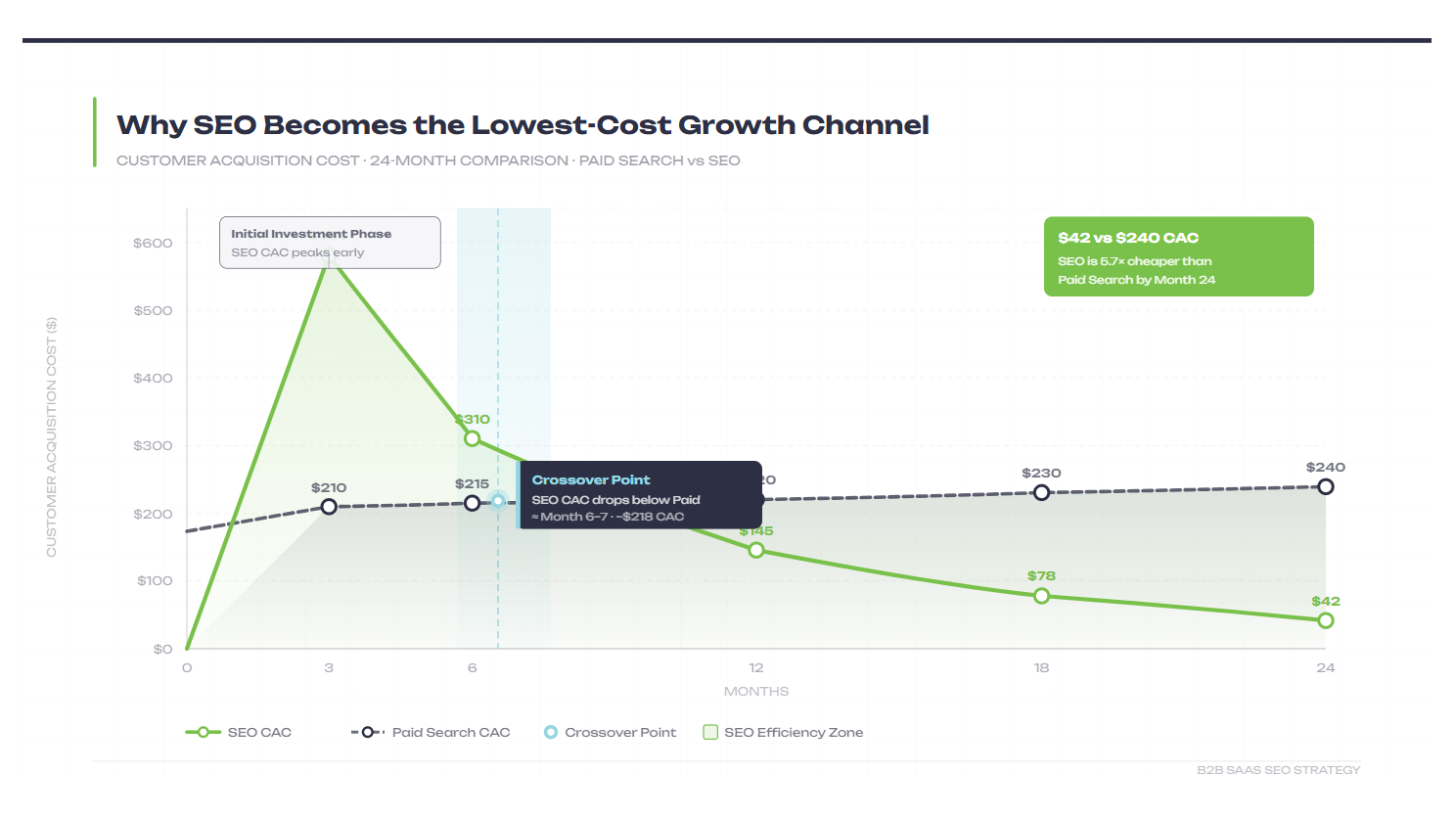
Insight: Paid CAC expands over time due to competition and platform saturation. SEO CAC compresses because the content asset base grows without proportional cost increases. At month 24, the same content that cost $8K to produce is generating leads at $42 CAC. That asset doesn’t depreciate.
The KPIs That Earn You Budget (And the Ones That Get You Fired)
If you walk into a board meeting and lead with “we grew organic traffic by 34% this quarter,” you will get a nod and a polite question about when it converts to revenue. If you walk in and say “organic search attributed $1.2M in pipeline this quarter, at a CAC of $61 versus $240 for paid,” you get budget and headcount.
The difference is not the performance of the program. It’s the measurement framework.
KPIs that earn you budget:
- Organic-attributed pipeline ($) – CRM-tracked pipeline where organic was first or last touch. This is the single most persuasive number in any executive conversation about SEO investment.
- Organic CAC vs. paid CAC – Run this comparison quarterly. At 18 months, the differential should be compelling enough to shift budget allocation.
- Share of voice on BOFU keywords – What percentage of your target BOFU keyword set are you ranking in the top 3 for? This is a leading indicator of future pipeline.
- Organic-attributed ARR – For SaaS with available attribution, track what closed ARR had an organic touchpoint. This number grows slowly at first and then becomes one of the most powerful justifications for continued SEO investment.
KPIs that will get you deprioritized:
- Sessions and pageviews without pipeline context
- Keyword rankings without conversion data attached
- Domain authority as a standalone metric
- “Content published” velocity without quality thresholds
The rule: every metric you report should be traceable to either revenue impact or a clearly understood leading indicator of revenue impact. Traffic metrics that don’t connect to that chain are vanity metrics, regardless of how large they are.
Mistakes That Silently Kill SaaS SEO Programs
These are the patterns that show up consistently across SaaS companies whose SEO programs underperform. None of them are obvious. All of them are expensive.
Cannibalization from over-publishing. Producing 10 articles targeting variations of the same keyword doesn’t multiply your ranking chances, it splits them. Google picks one and ignores the rest, and often picks the wrong one. Before publishing, confirm whether existing content already ranks or is eligible to rank for the same query. Either consolidate or clearly differentiate the angle.
Refreshing content by rewriting it instead of improving it. When a ranking page loses position, the instinct is to rewrite it. That’s usually wrong. Content loses rankings because something else became more relevant, earned more links, or better matched current search intent. Identify what changed, update specifically for that gap, add new data, fix structural problems and don’t start from scratch unless the content is fundamentally misaligned with current intent.
Ignoring JavaScript rendering at scale. If your SaaS marketing site is built on a modern JavaScript framework without server-side rendering configured correctly, Google may be crawling a shell of your pages rather than the rendered content. This is one of the most common invisible ranking suppressors in SaaS. Confirm with Google Search Console’s URL Inspection tool that what Google renders matches what users see.
Treating the blog as the entirety of SEO. The blog is one asset class. Pricing pages, landing pages, comparison pages, integration pages, and feature pages are all SEO surfaces. Some of the highest-converting organic pages a SaaS company can own have nothing to do with the blog.
No internal linking governance. New content that isn’t linked from any existing high-authority page on your site takes months longer to rank than it should. Build a simple protocol: every new page published gets at least three contextual internal links from existing pages with relevant traffic. This is a 30-minute task per publish that consistently moves ranking timelines forward.
AI Search, LLMs, and What It Means for SaaS Organic Growth
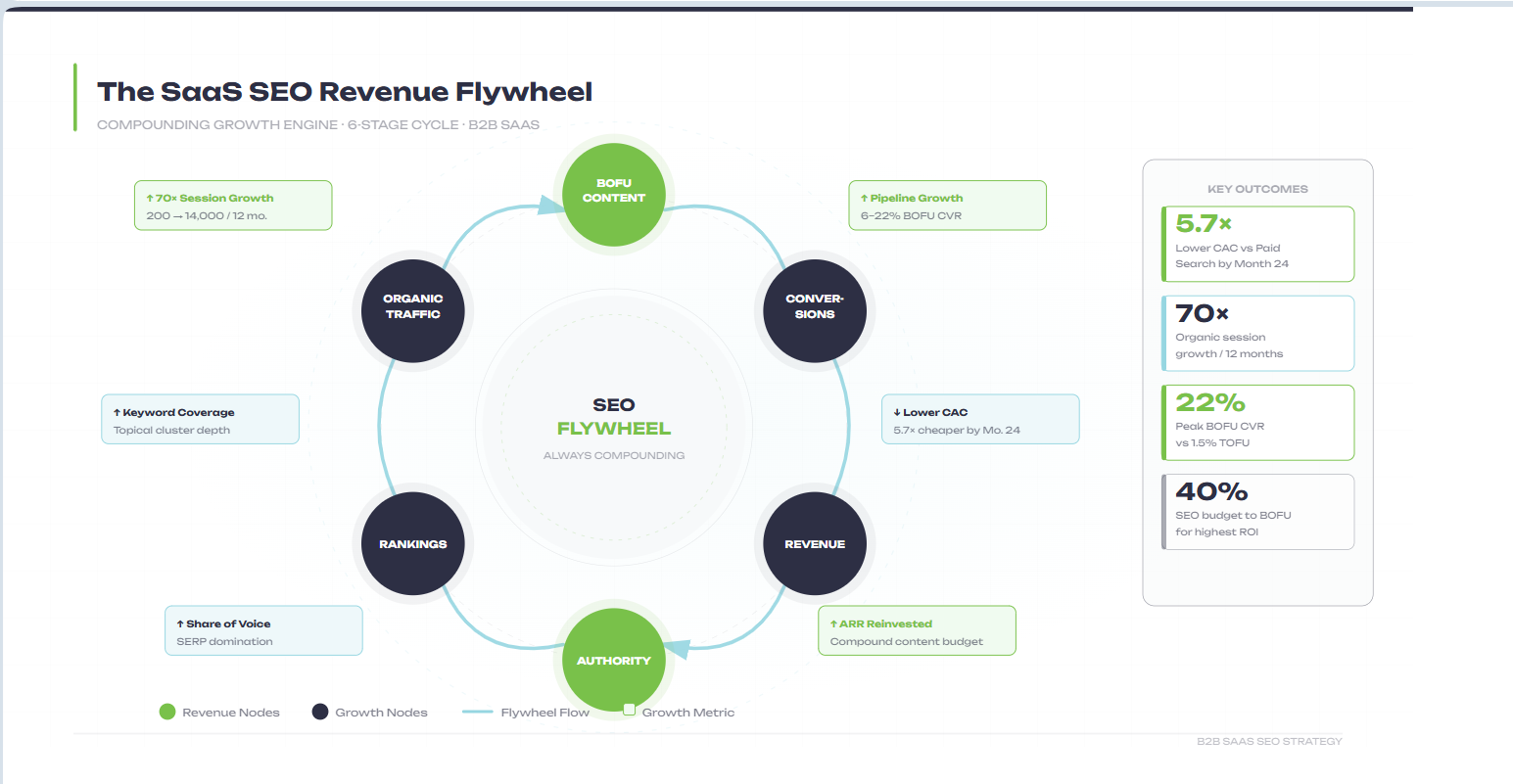
The SaaS companies asking “should we worry about AI search?” are asking the wrong question. The right question is: “are we the kind of brand that AI models cite when someone asks about our category?”
Gartner projects that by 2027, search engine volume will decline by 25% as AI-assisted tools absorb informational queries. For SaaS companies, this shift is less threatening than it sounds because most of the queries that matter for pipelines are not pure informational queries. The buyer typing “[Competitor] alternative” or “[Your Tool] pricing” is not asking ChatGPT for a summary. They want a clickable result that leads to a credible source they can evaluate. That behavior is stickier.
Where AI search does change SaaS SEO strategy:
Brand visibility in LLM outputs is a new SEO surface. When ChatGPT or Perplexity answers “what are the best tools for [your category],” the brands it names are the brands with strong organic authority, consistent mentions across the web, and high-quality indexed content. Being cited in AI answers is not a paid placement it’s earned through the same signals that drive organic rankings, plus breadth of brand mentions across credible sources. Your link building, digital PR, and review management strategies all feed into this.
Structured, directly-answerable content performs better in both worlds. AI Overviews in Google which now appear on a significant percentage of commercial queries draw from content that answers the question clearly, uses structured formatting, and includes specific, citable data points. This is also how well-written content has always worked. The difference is the bar for “clear and direct” is now higher.
Thin content is more exposed than ever. AI models trained on the web don’t need to rank your 600-word “what is [category]” post — they already know the answer and will provide it themselves. The only organic content that survives AI search commoditization is content that contains proprietary data, specific expertise, or direct product comparison information that the AI doesn’t have access to. Your original research, your customer case studies, your product-specific comparison pages are AI-resistant because they contain information the model can’t replicate.
This isn’t the end of SaaS SEO. It’s a quality threshold increase that benefits SaaS teams who were already doing the work correctly and exposes programs that were surviving on volume.