

If you’ve spent any time in the SaaS world recently, you’ve probably heard the term “product led growth” thrown around in strategy meetings, investor decks, and startup blogs. But what is product led growth, exactly? And why are some of the fastest-growing software companies on the planet like Slack, Figma, Notion, Dropbox are crediting it as the engine behind their billion-dollar valuations?
I have tried breaking this from the ground up. Whether you’re a founder, a product manager, or just someone trying to understand why your favorite SaaS tool gave you a free tier, you’re in the right place.
What is Product Led Growth, Really?
Product led growth (PLG) is a go-to-market strategy where the product itself is the primary driver of customer acquisition, conversion, retention, and expansion rather than a sales team or a marketing campaign.
To simplify: instead of hiring a sales battalion to convince people to buy your software, you let people use your software first. If it delivers enough value quickly enough, users will convert to paying customers, invite their colleagues, and expand usage across their organization all without a sales ninja ever picking up the phone.
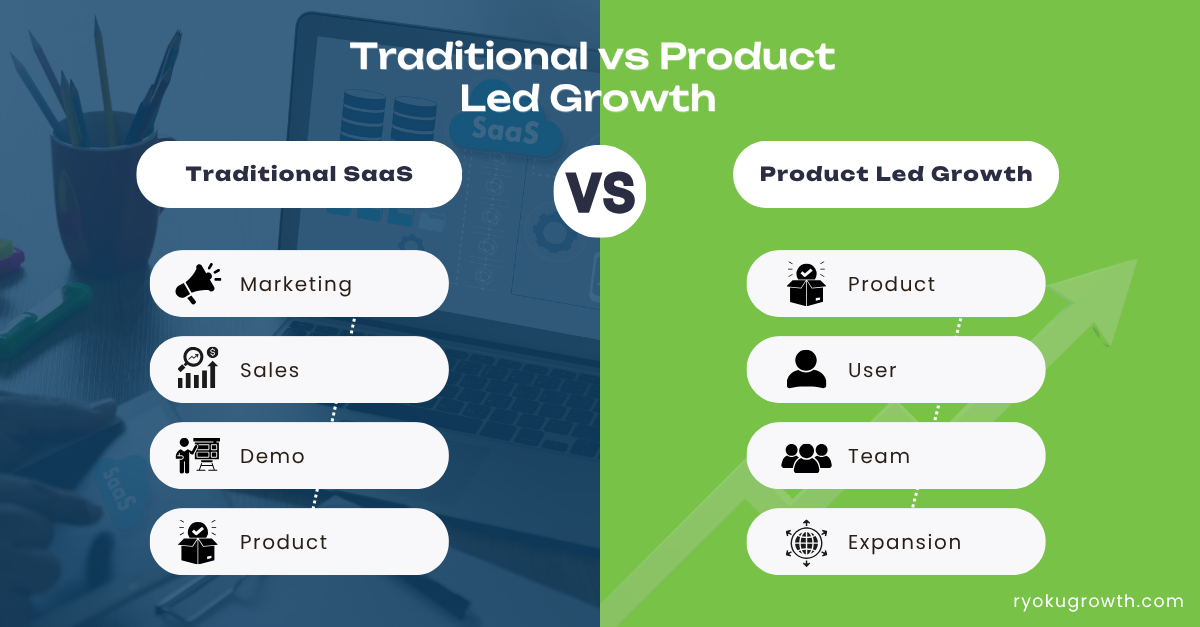
Think of it this way. In a traditional software sale, the journey looks like this:
Marketing generates a lead → Sales runs a demo → Legal reviews the contract → The customer finally gets to use the product.
In a product led growth model, that entire sequence is flipped:
User discovers the product → Signs up→ Experiences real value → Invites their team → Company eventually buys a paid plan.
The product isn’t just what you’re selling, it’s your sales channel, your marketing engine, and your customer success team, all rolled into one.
The term was coined by Blake Bartlett at OpenView Partners around 2016, though the strategy itself had been quietly powering companies like Atlassian (founded in 2002) and Dropbox (founded in 2007) for years before anyone gave it a formal name.
Sales-Led vs. Marketing-Led vs. Product Led Growth
To truly understand what product led growth means, it helps to see it side by side with the approaches it’s disrupting.
Sales-led growth is the traditional enterprise software model. Think IBM, Oracle, and Salesforce. A company hires account executives who prospect outbound, run lengthy demos, negotiate contracts, and shepherd deals through a procurement process that can take six to eighteen months. The product is often only seen after the contract is signed. This model works for complex, high-ACV (Annual Contract Value) deals but it’s expensive, slow, and increasingly out of sync with how modern buyers discover and evaluate software.
Marketing-led growth puts advertising, content, and demand generation at the front of the funnel. The goal is to generate leads that sales can then close. It works, but it’s capital-intensive and you’re essentially buying attention rather than earning it through product value.
Product led growth is the third path. It reduces (and in some cases eliminates) the friction between “discovering your product” and “experiencing its value.” Users can self-serve their way to an “aha moment” without ever talking to a human. The product becomes the primary vehicle for demonstrating value, building trust, and ultimately converting free users to paying customers.
This doesn’t mean PLG companies don’t hire Salesforce, they do. But those sales teams work with the product, focusing on expanding accounts that have already proven adoption, rather than convincing cold prospects from scratch.
| Attribute | Sales-Led Growth | Marketing-Led Growth | Product Led Growth |
| Primary growth driver | Sales team | Advertising & content | The product itself |
| Customer first touches product | After contract is signed | After lead is qualified | Before any purchase decision |
| Typical sales cycle | 6–18 months | 2–6 months | Days to weeks |
| Customer Acquisition Cost | Very high | Medium–High | Low–Medium |
| Scalability | Limited by headcount | Limited by ad spend | Scales with product usage |
| Best for | Complex enterprise software | Brand-driven B2C or B2B | Self-serve SaaS, collaboration tools |
| Revenue model | Large upfront contracts | Subscription or one-time | Freemium, usage-based, or subscription |
| Key metric | Pipeline value & quota attainment | MQLs & lead volume | Activation rate & PQLs |
The Core Principles Behind Product Led Growth
Understanding what product led growth is requires understanding the principles that make it work. These aren’t tactics, they’re fundamental beliefs about how software should be built and distributed.
1. The Product Must Deliver Value Before the Paywall
The defining characteristic of a PLG product is that users experience genuine, meaningful value before they’re asked to pay for it. This isn’t a watered-down preview, it’s real utility that solves a real problem. The free tier of Notion lets you build a genuinely functional workspace. Slack’s free tier lets your team communicate and search through the last 90 days of messages. Figma’s free plan lets designers collaborate in real time. The generosity of the free experience is intentional: it builds habit, trust, and dependency.
2. Time-to-Value is Everything
In a PLG model, the speed at which a new user reaches their “aha moment”, the instant they understand why this product matters is the most critical metric of all. The best PLG companies obsess over removing every possible obstacle between signup and that first moment of genuine value. No lengthy onboarding forms. No mandatory demos. No credit card required. Just: sign up, get in, experience something useful.
3. Virality is Built Into the Product
PLG companies don’t rely on referral programs with cash incentives; they engineer virality into the core experience. When a designer shares a Figma file with a developer, that developer has to create a Figma account to view it. When a manager creates a Calendly scheduling link, everyone who clicks it is exposed to Calendly. When a team adopts Slack, every new hire added to the workspace becomes a user automatically. The product spreads because using it requires others to use it.
4. Self-Service is Non-Negotiable
A PLG product must be discoverable, adoptable, and expandable without requiring human assistance. Users should be able to upgrade, downgrade, invite teammates, and explore new features entirely on their own. This is why in-app onboarding, contextual tooltips, interactive tutorials, and transparent pricing pages are treated as first-class product features not afterthoughts handled by the customer success team.
5. Data Drives Every Decision
Because users self-serve their way through the product, PLG companies accumulate rich, granular data about how people actually use their software. This data becomes a competitive advantage that fuels product improvements, identifies conversion opportunities, and reveals where users are dropping off. Concepts like Product Qualified Leads (PQLs) users who have reached specific behavioral thresholds that predict purchase intent emerge from this data-first mindset.
Why Product Led Growth Works: The Numbers
If you’re still wondering what the fuss is about, the data makes the case compelling.
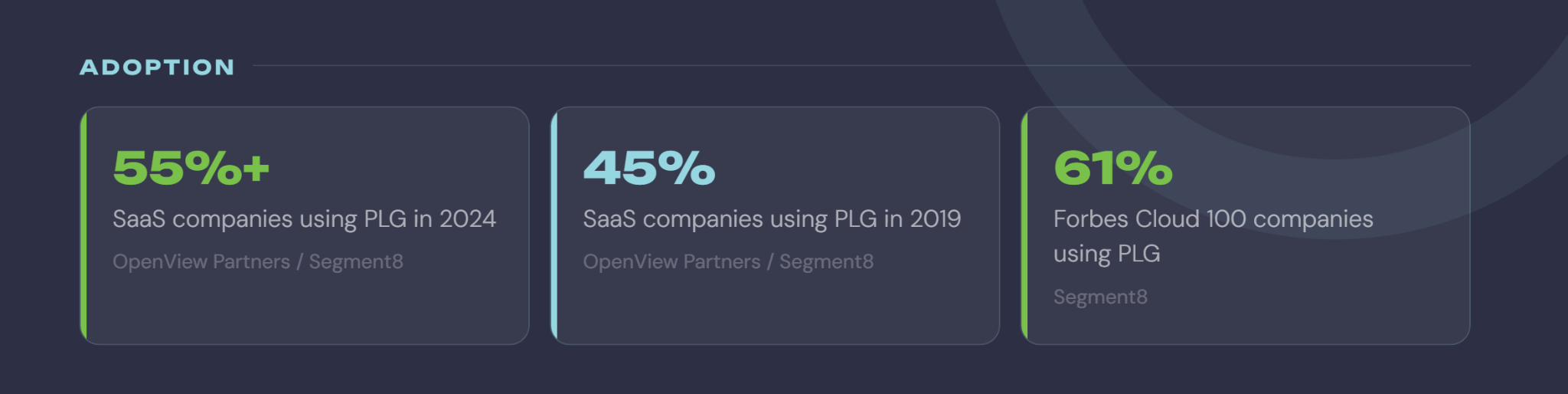
PLG adoption has surged. According to OpenView Partners, PLG adoption grew from 45% among SaaS companies in 2019 to over 55% by 2024. More than half of software companies now use product led growth as their primary or co-primary go-to-market strategy.
PLG companies grow faster. Product led growth companies have been shown to grow at approximately 50% year-over-year, compared to around 21% for traditional SaaS companies on a sales-led model more than twice the pace.
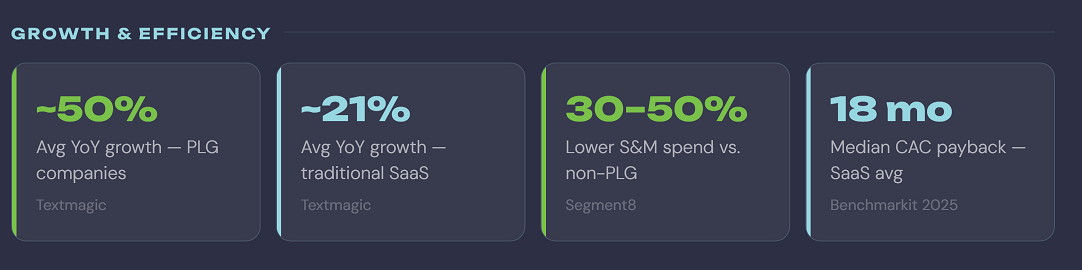
PLG companies are more capital-efficient. The median CAC payback period across SaaS is 18 months, but PLG companies consistently achieve 30–50% lower sales and marketing costs relative to revenue because the product does much of the acquisition work autonomously.
The top companies are all doing it.
61% of Forbes’ Cloud 100, the most valuable private cloud companies in the world employ PLG strategies.
Freemium conversion rates are real.
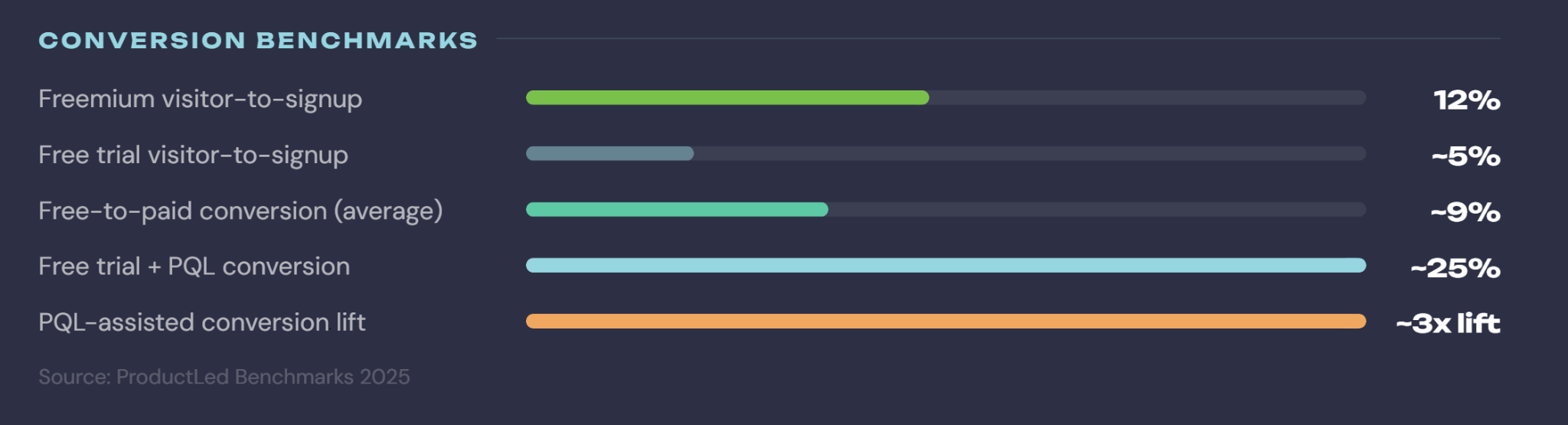
When PLG companies adopt freemium models, the median visitor-to-signup conversion sits at 12%, which is 140% higher than the conversion rate of free trial models. Average free-to-paid conversion across models lands around 9%, and companies that deploy Product Qualified Leads see conversion rates approximately 3x higher than those that don’t.
These aren’t outliers. They represent a structural shift in how software is bought and sold.
What are Product Led Growth Examples? Real Companies, Real Results
The best way to understand product led growth in practice is to look at the companies that have mastered it. These product led growth examples illustrate the strategy in action across different industries and product types.
Slack – Viral Team Adoption
Slack is the canonical PLG success story. Launched in 2013 as a simple team communication tool, it grew to over 285,000 daily active users in its first year purely through word-of-mouth and organic virality, without any traditional outbound marketing at launch. Its freemium model was designed so that individual users could sign up in minutes, invite colleagues, and start communicating immediately. The product’s social nature meant that every person who joined brought in more people. Slack’s natural paywall, the 90-day message history limit created a gentle but real pressure to upgrade without ever requiring a hard sell. Slack was ultimately acquired by Salesforce for $27.7 billion.
Figma – Collaboration as the Growth Engine
Before Figma, design work was siloed. Designers used desktop apps, emailed files back and forth, and managed version chaos. Figma’s entire value proposition was built around real-time, browser-based collaboration and that collaborative architecture became the growth engine.
When one designer invited a developer or product manager into a Figma file, a new user was born. The person receiving the invite had to create an account to view or comment on the file. Figma’s free plan was generous enough for individuals and small teams to get real value, while the collaborative nature of the product naturally pulled in more users. Figma crossed $1 billion in annual revenue run rate while demonstrating what happens when virality is baked into the product’s DNA.
Dropbox – The Referral Flywheel
Dropbox solved a simple, universal problem: reliably syncing files across multiple devices. But its growth wasn’t just about product utility, it was about a brilliantly engineered referral loop. Users got 2 GB of free storage at signup, but could earn up to 16 GB by referring friends. Both the referrer and the new user received extra storage, creating a mutual incentive that spread Dropbox virally across the internet. This was one of the first and most successful examples of PLG in action: the product’s value was the incentive, and users became the acquisition channel.
Notion – Community as a Growth Multiplier
Notion’s rise illustrates an evolution of the PLG model. Its generous free personal plan lets individuals use the product at zero cost, removing all friction for individual adoption. But its most powerful growth mechanism was community-driven: users created YouTube tutorials, Reddit threads, and extensive template galleries, driving organic discovery entirely independent of Notion’s marketing team.
The product’s flexibility meant users could adapt it to almost any use case not limiting to personal notes, project management, company wikis and then share those use cases publicly, creating a self-sustaining content engine. Notion reached a $10 billion valuation and 20 million+ users, with users growing 5x.
Canva – Democratizing Design
Canva took a traditionally complex, professional skill of graphic design and made it accessible to anyone with a browser. Its free tier gave users access to a powerful drag-and-drop design tool with thousands of templates. The product’s inherent shareability meant that every design someone created became a piece of content that could expose new users to the Canva brand.
Canva now reports 260 million monthly active users and $3.5 billion in ARR, growing at 40%+ per year. It’s one of the most striking illustrations of how PLG can work outside the B2B SaaS world.
The Key Strategies Behind a Successful PLG Motion
Knowing what product led growth is in theory is one thing. Knowing how to actually implement it is another. Here are the core strategic components of a successful PLG motion:
Freemium and Free Trial Models
The entry point to almost every PLG strategy is some form of free access. The two primary models are:
- Freemium: A permanently free tier with limited features or usage capacity, and a paid tier that unlocks more. Works best when the free experience is genuinely valuable and the upgrade path is clear and natural.
- Free trial: Full access to the product for a limited time (typically 14–30 days), after which users must convert to a paid plan. Works better for higher-ACV products where the conversion decision needs time but the paywall creates urgency.
When companies first adopt PLG, 75% choose one of these two models. The right choice depends on your product’s complexity, price point, and the speed at which users typically discover its core value.
In-App Onboarding
In a sales-led world, onboarding is done by a customer success manager walking a new customer through the product. In PLG, the product has to do that job itself. This means investing heavily in:
- Contextual tooltips that explain features in the moment they’re relevant
- Interactive product tours that guide users through key workflows on their first login
- Progress checklists that gamify the onboarding experience and push users toward activation milestones
- Empty state UI that shows users what a fully-utilized product looks like, removing the “blank canvas” intimidation
The goal of all of this is singular: get the user to their “aha moment” as fast as possible.
Product Qualified Leads (PQLs)
One of the most powerful concepts in product led growth is the Product Qualified Lead. Rather than qualifying potential customers based on firmographic data (company size, industry, job title), a PQL is defined by behavioral data specific in-product actions that correlate with purchase intent.
For Dropbox, a PQL might be a user who has stored more than 1 GB of files. For Slack, it might be a team that has sent more than 2,000 messages. For a project management tool, it might be a user who has created a project and invited at least two team members. Companies that use PQL-based outreach see conversion rates approximately 3x higher than those relying on traditional lead qualification, because they’re reaching users who have already proven they value the product, not just users who fit a demographic profile.
Viral and Network Effects
The most defensible PLG companies aren’t just easy to try, they become more valuable as more people use them. This is the concept of network effects applied to growth strategy. Slack becomes more useful the more of your colleagues are on it. Figma becomes more useful when your whole product team is collaborating in it. The product’s value is inherently social, which means every new user creates the conditions for more users to follow.
Alongside network effects, many PLG companies engineer product-led virality mechanisms where the act of using the product exposes it to new audiences. A Calendly scheduling link. A Loom video. A Notion page shared publicly. A Typeform survey embedded in a website. All of these are products that carry their brand into the world automatically.
Self-Service Support
In a traditional SaaS business, support is a cost center. In PLG, self-service support infrastructure is a core part of the product experience. This means:
- Comprehensive, searchable documentation
- In-app chatbots for common questions
- Community forums where users help each other
- Video tutorials embedded in the product itself
When users can resolve their own questions without waiting for a human response, time-to-value stays low, frustration stays low, and retention stays high.
Who is Product Led Growth Best For?
Product led growth isn’t a universal solution. It works best in specific contexts, and understanding those contexts helps you decide whether it’s the right strategy for your business.
PLG is typically best suited for:
- B2B SaaS products with low-to-moderate complexity, where users can realistically understand the product’s core value within minutes or hours of first use
- Collaboration tools where the product’s value increases with the number of users, making viral adoption a natural by-product of normal usage
- Products with a clear, demonstrable “aha moment” something a user can experience quickly without requiring extensive setup or data migration
- Products targeting individual contributors or small teams first, who can adopt the product independently before the purchase decision is escalated to a budget holder
- Horizontal tools that can be used across multiple departments or use cases, enabling organic expansion within organizations
PLG is harder (though not impossible) for:
- Highly complex enterprise products that require significant customization, integration work, or organizational change management before delivering value
- Products with a long time-to-value where the benefit of using the product only becomes apparent after weeks or months
- Products in highly regulated industries where procurement, security review, and compliance approvals are non-negotiable preconditions to any usage
- Niche products with very small total addressable markets where the viral mechanics of PLG have limited room to operate
It’s worth noting that the lines here are blurring. Many traditionally sales-led enterprise software companies are now adding PLG motions offering free tiers, improving self-serve onboarding, and using product usage data to qualify enterprise deals. The future isn’t purely PLG or purely sales-led, it’s a smart hybrid of both.
PLG and the Concept of Product-Led Sales (PLS)
One of the most important nuances in the product led growth conversation is the relationship between PLG and sales. The misconception is that PLG replaces sales. The reality is more interesting.
The most successful PLG companies don’t eliminate sales, they evolve it. This hybrid approach is called Product-Led Sales (PLS). Here’s how it works: the product generates a large base of active free users. Product analytics identify the users and accounts that have reached behavioral thresholds indicating they’re ready for a paid conversation (the PQLs we discussed earlier).
A sales team then reaches out not to demo the product to a cold prospect, but to expand an account that’s already deriving value.
Slack is the textbook example. Individual teams would adopt Slack for free, and the product would spread organically within an organization. Once enough teams were using it, Slack’s sales team would engage the IT department about an enterprise-wide deployment.
The sales conversation shifted from “let me convince you this is valuable” to “your company is already using this. Let’s talk about consolidating and expanding.” That’s a fundamentally different (and far more efficient) sales motion.
This is why building your PLG strategy doesn’t mean defunding your sales team. It means giving them better leads, better data, and a product that has already done the hard work of proving its value.
The Metrics That Matter in Product Led Growth
If you’re implementing PLG, you need to be measuring different things than a traditional sales-led business. The key metrics to track include:
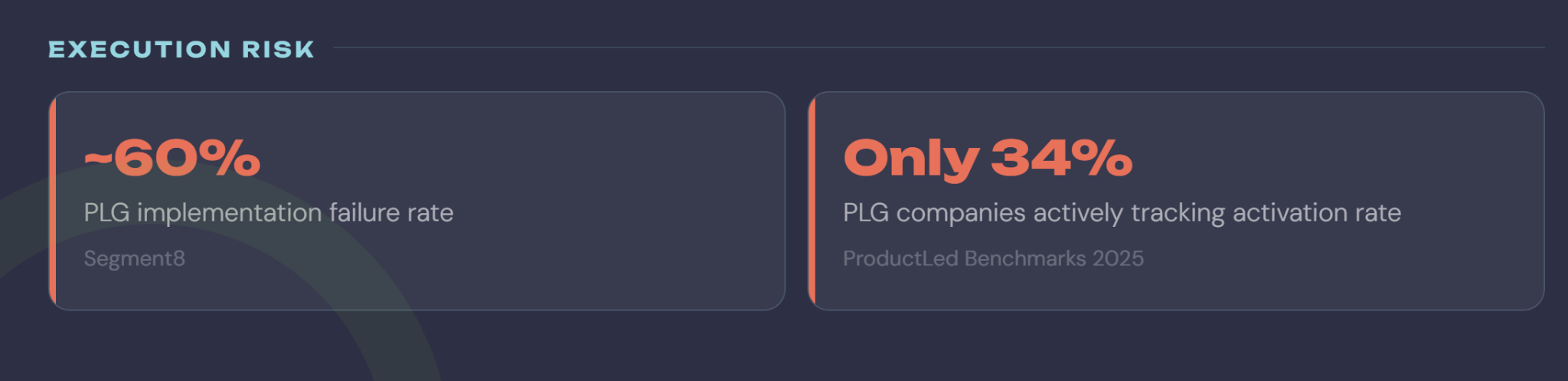
Activation Rate: The percentage of new signups who reach the product’s “aha moment.” This is the single most important metric in PLG. Most high-performing companies target activation rates above 25% and treat anything below 15% as a sign that onboarding needs serious work. Only 34% of PLG companies actually track this consistently meaning the majority are flying blind on their most critical metric.
Time-to-Value (TTV): How quickly a new user reaches their first moment of genuine utility. The best PLG companies measure TTV in hours, not days.
Free-to-Paid Conversion Rate: The percentage of free users who upgrade to a paid plan. Industry benchmarks put the average around 9%, with top performers in the 20–25% range.
Product Qualified Lead (PQL) Conversion Rate: The percentage of users who reach PQL thresholds and then convert to paid. Companies using PQLs report conversion rates approximately 3x higher than those relying on traditional lead scoring.
Net Revenue Retention (NRR): How much revenue you’re retaining and expanding from your existing customer base, accounting for upgrades, downgrades, and churn. PLG companies often see strong NRR because product-led expansion (users naturally using more features or adding more seats) is built into the growth model.
Viral Coefficient: How many new users each existing user generates through invites, shares, or referrals. A viral coefficient above 1 means the product is growing on its own. Most PLG companies target a coefficient between 0.3 and 0.7 as a strong signal of organic growth momentum.
What Product Led Growth Actually Requires From Your Organization
Here’s something the hype often glosses over: PLG is not just a marketing strategy or a pricing decision. It’s a company-wide operating model, and the data bears this out. Studies show a 60% failure rate among companies attempting to implement PLG not because the strategy is flawed, but because execution requires deep cross-functional alignment that most organizations underestimate.
Product-led growth requires:
Engineering investment in the self-serve experience. Your signup flow, onboarding sequence, in-app guidance, and billing infrastructure all need to be engineered to enable zero-touch adoption. This is product work, not marketing work.
A product team obsessed with activation. The product team needs to own the user journey from signup to activation, which means understanding behavioral data, running rapid experiments, and treating the onboarding experience as mission-critical not as a post-launch cleanup task.
A marketing team that generates PLG demand. Content, SEO, community-building, and product-led marketing campaigns that drive users directly into the self-serve funnel replace (or supplement) traditional lead generation.
A sales team that works from product data. Sales reps in a PLG company are more like expansion consultants than traditional closers. They need access to product usage dashboards and the ability to identify and prioritize PQLs.
Customer success that supports free users. A PLG model means your free users deserve support because today’s free user is tomorrow’s enterprise customer. Companies where customer success is empowered to engage with free accounts see significantly better conversion rates.
Actionable Takeaways: Where to Start
If you’re exploring product led growth for your business, here’s where to focus your energy first:
Define your “aha moment.” What is the single action a user can take in your product that makes them think “I can’t imagine working without this”? Everything in your PLG strategy, your free tier, your onboarding, your activation metrics should be engineered to get users to that moment as fast as possible.
Audit your time-to-value ruthlessly. Map every step between a user discovering your product and reaching that aha moment. Remove every unnecessary step, form field, confirmation click, and loading screen. PLG products win by reducing friction to near zero.
Start with a freemium model if your product allows it. If your product can deliver real value to users without compromising your paid plan’s appeal, freemium is typically the highest-leverage entry point into a PLG motion. The 12% visitor-to-signup conversion rate for freemium versus the ~5% for free trials makes this a significant acquisition advantage.
Build a PQL framework before you need it. Even if your free user base is small, start defining which behaviors signal purchase intent. Review the users who have already converted organically and reverse-engineer what actions preceded that conversion. This becomes the foundation of your PQL scoring model.
Measure activation, not just signups. Vanity metrics like raw signups are easy to grow. Activation rate tells you whether those signups are actually experiencing the value your product promises. If your activation rate is low, no amount of acquisition spending will fix a fundamentally broken product experience.
Invest in self-serve infrastructure early. Documentation, in-app help, community forums, and FAQ libraries aren’t exciting to build. But they’re the scaffolding that allows your product to grow without proportionally growing your support headcount.
The Bottom Line on Product Led Growth
Product led growth represents a fundamental shift in how software companies think about building, distributing, and monetizing their products. It’s not a growth hack or a pricing trick, it’s a philosophy that says: if your product is genuinely valuable, let people experience that value first and trust that conversion, expansion, and loyalty will follow.
The evidence is overwhelming. The fastest-growing SaaS companies in the world have built their businesses on this foundation. PLG adoption among SaaS companies has crossed 55%, and 61% of the most valuable private cloud companies use it as a core strategy. PLG companies grow at more than twice the rate of their sales-led counterparts while spending significantly less on sales and marketing.
Understanding what product led growth is and what it demands of your product, your team, and your organization is no longer optional for anyone building or growing software. Whether you’re launching a new product or evolving an existing go-to-market strategy, the principles of PLG offer a more sustainable, more scalable, and ultimately more customer-centric path to growth.
The companies that win in the next decade of software won’t be the ones that outspend competitors on ads or outstaff them in sales. They’ll be the ones that build products so good that users become their most powerful growth engine.