
If you are running a B2B SaaS company and still treating SEO as a “nice to have,” here is the reality check you need: organic search is now responsible for 44.6% of all B2B revenue — more than paid ads, email, and social media combined.
That number is not a typo.
I have watched SEO evolve from a keyword-stuffing exercise into the single most powerful compound growth lever available to a SaaS business. And in 2026, with AI fundamentally reshaping how buyers find software, the rules have shifted yet again.
This b2b saas seo guide is not a checklist of things to do. It is a strategic blueprint built from what actually works; from the decisions that separate SaaS companies ranking on page one from those invisible to their best-fit buyers.
Whether you are a founder building your first SEO program or a VP Marketing trying to scale what already works, this guide will give you the frameworks, data, and sequencing to do it right.
Key Takeaways Before You Dive In
- Organic search drives 53% of all SaaS website traffic — it is your biggest acquisition channel whether you have optimized for it or not.
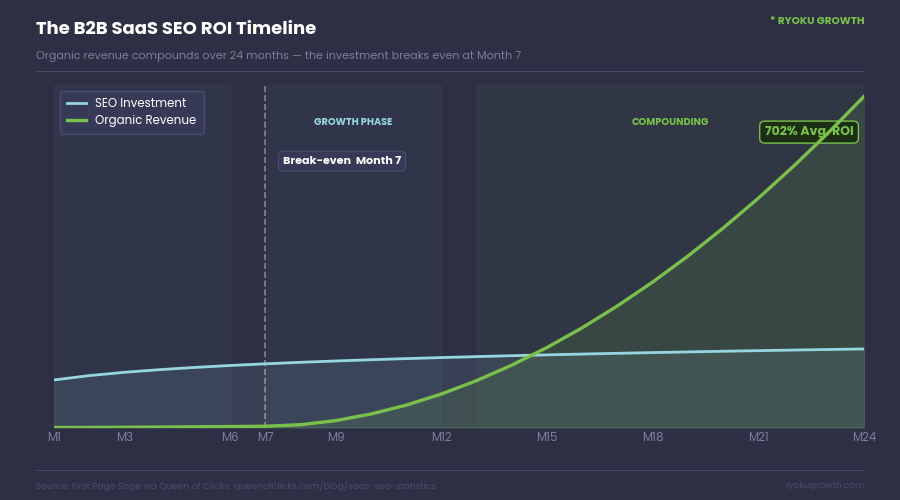
- B2B SaaS companies achieve an average SEO ROI of 702%, with break-even typically hit in 7 months.
- 83% of B2B buyers research independently before ever speaking to your sales team. If you are not showing up in that research phase, a competitor is.
- Technical SEO is not optional. 96.55% of all web pages receive zero organic traffic from Google — most of them have fixable technical issues.
- AI Overviews now appear on 13.14% of all Google searches, fundamentally changing click behavior and making brand authority more critical than ever.
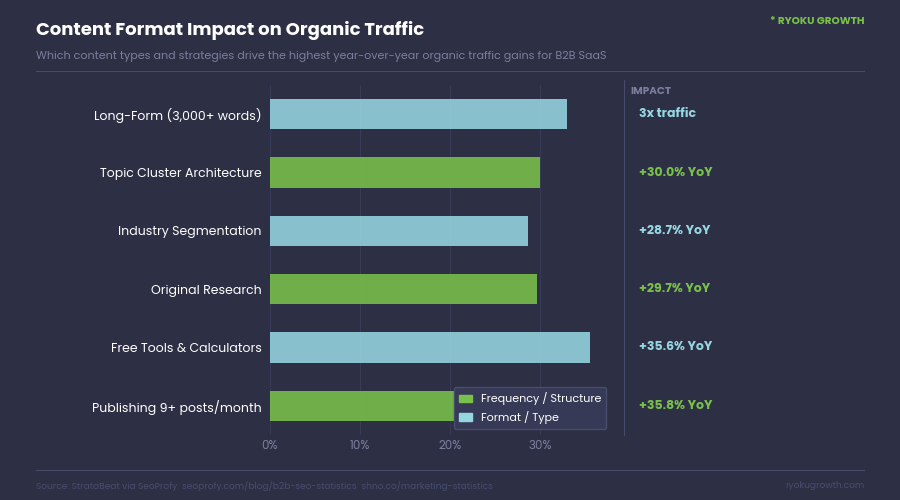
- Topic clusters and audience segmentation by industry drive 28.7% more organic traffic than generic content strategies.
Why SEO for B2B SaaS Hits Different in 2026
Most SEO guides treat B2B SaaS like any other website. That is a mistake. The SaaS buying journey is long, research-heavy, and involves multiple-stakeholders, which means your SEO strategy has to be built differently from the ground up.
Consider how your buyers actually behave: 57% of B2B decision-makers start their product research using search engines, and 40% of software buyers spend several weeks or months researching before making a purchase. They are not clicking one article and buying. They are consuming 4.5 pieces of content on average before even reaching out to a salesperson.
This means your SEO program is not just about getting traffic. It is about owning the entire self-education journey your buyer goes through before they ever see a demo.
The math on why this matters is also compelling. While a paid ad stops driving results the moment your budget runs out, a well-optimized piece of content can drive qualified traffic for years. The average age of a page ranking in the top 10 results is at least two years. You are building an asset, not renting attention.
And the competition is real. There are approximately 98,146 SaaS products in market, with 88% of them classified as B2B. Every single one of them is competing for the same buyer attention in search.
Building a B2B SaaS SEO Strategy That Actually Compounds
The biggest mistake I see SaaS companies make is treating SEO as a tactical list rather than a compound system. A proper saas seo strategy has three interlocking parts: the right keyword framework, a content architecture that builds authority, and a technical foundation that lets everything else work. Miss any one of them and you are leaving significant growth on the table.
The Keyword Framework for SaaS: Think in Jobs, Not Terms
Stop starting with keyword volume. Start with the jobs your buyer is trying to do.
When I was working on organic strategy for an enterprise SaaS platform, we would map every keyword to a buyer intent: Are they trying to understand a problem? Evaluate solutions? Compare specific vendors? This framework, sometimes called Jobs-to-Be-Done keyword mapping, produces a much more useful content roadmap than sorting a spreadsheet by search volume.
For SaaS, there are four keyword categories that matter most:
1. Problem-Aware Keywords (“how to reduce customer churn,” “why sales teams miss quota”) These bring in buyers early in their research. High traffic, lower conversion, but essential for building topical authority and familiarity.
2. Solution-Aware Keywords (“customer success software,” “sales enablement platform”) These are buyers who know the category but haven’t picked a vendor. High commercial intent, highly competitive.
3. Comparison and Alternative Keywords (“HubSpot vs Salesforce,” “best Salesforce alternatives”) These convert at extraordinary rates and are often neglected. A buyer searching “alternative to [competitor]” is minutes away from a demo request.
4. Integration and Use-Case Keywords (“Salesforce Slack integration,” “how to use Slack for project management”) These work double duty; they attract buyers AND they retain existing customers who become advocates.
One critical insight from the data: B2B SaaS websites that segment content by industry saw 28.7% organic traffic growth, compared to just 4.1% for those without segmentation.
This means creating industry-specific landing pages (“CRM for healthcare,” “project management for construction firms”) is not just good UX — it is a proven SEO multiplier.
Topic Clusters: The Architecture That Signals Expertise
Random blog posts do not build authority. Topic clusters do.
A topic cluster is a hub-and-spoke content model where one comprehensive pillar page (like the one you are reading) covers a broad topic, and multiple supporting pieces go deep on specific subtopics — all linking back to the pillar.
The results are significant: content grouped into topic clusters drives approximately 30% more organic traffic and holds rankings 2.5 times longer than standalone pieces. When I built the content architecture for Vidyard’s organic program, moving from isolated posts to clusters was the single highest-leverage change we made.
Here is a simple topic cluster map for a sales enablement SaaS:
Pillar: The Complete Guide to Sales Enablement
- Supporting: What is Sales Enablement?
- Supporting: Sales Enablement vs. Sales Training
- Supporting: Best Sales Enablement Tools (Comparison)
- Supporting: How to Build a Sales Enablement Strategy
- Supporting: Sales Enablement KPIs and Metrics
- Supporting: Sales Enablement for Remote Teams
Every supporting piece links to the pillar. The pillar links to every supporting piece. Google sees a cohesive body of expertise, not a random collection of articles.
Technical SEO for SaaS – The Foundation You Can’t Skip
Here is a truth that most content-first marketers do not want to hear: you can write the best articles in your category and still rank nowhere if your technical foundation is broken. Technical SEO for SaaS is not glamorous, but it is where rankings are often won or lost before a single word is written.
The numbers tell the story starkly: 96.55% of all web pages receive zero organic traffic from Google. The reasons are overwhelmingly technical or authority-related — crawlability issues, thin content, duplicate pages, slow load times, and missing schema markup.
The Core Technical Priorities for SaaS Sites
Site Architecture and Crawlability
Your site structure signals priority to Google’s crawlers. Important pages should be reachable within 3 clicks from your homepage. For SaaS companies, this means your product pages, solution pages, and high-intent landing pages need to be prominently linked internally — not buried in footer nav.
One pattern I see constantly in SaaS: product tour pages, use case pages, and integration pages buried 5-6 clicks deep. These are some of the highest-converting pages you have. If Google’s crawler has to work hard to find them, users will never see them in search.
Page Speed: Mobile is Non-Negotiable
A 1-second improvement in mobile load time can improve conversions by up to 20%. For SaaS, which increasingly attracts mobile researchers (executives checking solutions during commutes), this is directly tied to the pipeline. Google’s Core Web Vitals, Largest Contentful Paint, Interaction to Next Paint, and Cumulative Layout Shift are ranking signals. Audit them quarterly at minimum.
Duplicate Content and Canonicalization
SaaS sites are notoriously prone to duplicate content. Dynamic filters, faceted navigation, UTM parameters creating URL variations, blog tag pages all of these can produce thousands of near-identical pages that dilute your crawl budget and confuse Google about which page to rank. A proper canonical tag strategy and a well-configured robots.txt file are essential housekeeping.
Schema Markup
This is the most underutilized technical tool in SaaS SEO. Structured data helps Google understand what your content is about and unlocks rich results in the SERP. For SaaS, the most impactful schema types are: FAQ schema (excellent for capturing featured snippets on high-volume informational queries) now being deprecated as of May 2026, Software Application schema (for product pages), and Review schema (for social proof).
Critically, sites with proper schema markup appear in ChatGPT and AI search responses 3.2x more frequently — making this a bridge between traditional SEO and the emerging AI search landscape.
HTTPS, XML Sitemaps, and Core Fundamentals
These are table stakes. Your sitemap should be dynamic, submitted to Google Search Console, and include only indexable, canonical URLs. If you are still running pages over HTTP in 2026, stop reading this and fix that immediately.
SaaS-Specific Technical Challenges
App Subdomains vs. Subfolders
Many SaaS companies serve their application from app.yourdomain.com and their marketing site from yourdomain.com. The problem: links pointing to your app subdomain do not pass authority to your marketing site. Wherever possible, run your marketing site on the root domain and use a subfolder structure (yourdomain.com/app/) for the application.
Free Tool Pages
The data here is striking: websites offering free online tools such as ROI calculators or TCO calculators increased organic traffic year-over-year by 35.6%. Tools earn backlinks naturally, drive repeat visits, and rank for high-intent calculation-type queries. If your SaaS solves a measurable business problem, build a calculator page around it.
Localization for Global SaaS
If you serve multiple regions, hreflang tags are not optional. Incorrect localization signals mean Google may show the wrong language version of your page to international visitors and destroy conversion rates on otherwise well-ranked pages.
Content That Earns Rankings AND Revenue
Content is the engine of seo for saas, but in 2026 the bar for what Google considers “quality” has moved significantly higher. The rise of AI-generated content has flooded the internet with mediocre text, and Google has responded by rewarding Experience, Expertise, Authoritativeness, and Trustworthiness (E-E-A-T) more aggressively than ever.
The Content Formats That Move the Needle in B2B SaaS
Not all content performs equally. Based on what I have seen work across multiple SaaS companies at scale, here is the honest ranking:
Original Research and Data Studies
This is the single highest-leverage content format available to SaaS companies. B2B SaaS websites that published original research increased organic traffic by an average of 29.7% versus 9.3% for those that did not — and saw 42.2% growth in backlinks, with 96.9% of those sites gaining more links overall.
When you produce proprietary data, you become the source that other writers cite. That is how you build domain authority at scale.
Long-Form Pillar Content
Articles over 3,000 words generate three times more traffic and four times more shares than average-length content. Long-form content also earns 1.5x to 3x more backlinks than short-form in B2B. This is not about padding , it is about being genuinely comprehensive on topics where your buyers need comprehensive answers.
Comparison and Alternative Pages
“Best [category] software,” “[Competitor] alternatives,” and “[Product A] vs [Product B]” pages are consistently among the highest-converting pages in any SaaS content program. Buyers at this intent level are close to making a decision. These pages often require significant upkeep but deliver an outsized pipeline.
Free Tools and Calculators
Already mentioned in the technical section, but worth repeating as a content strategy: interactive tools drive 35.6% more organic traffic year-over-year. They also generate the kind of natural backlinks that editorial outreach rarely produces.
Video with Transcripts
91% of marketers say video marketing has delivered good ROI, and Google indexes video transcripts. Embedding a YouTube video on a high-priority landing page, with a full transcript, can meaningfully improve on-page engagement metrics and expand the keyword surface area of the page.
Publishing Cadence: What the Data Actually Says
The relationship between publishing frequency and traffic growth is not linear — but it is real.
Companies publishing 9 or more blog posts focusing on originality and first source of information per month saw 35.8% year-over-year traffic growth, compared to 16.5% for those publishing 1-4 times monthly. Companies publishing 16 or more posts monthly generate 4.5x more leads than infrequent publishers. This is not going to be easy but achievable.
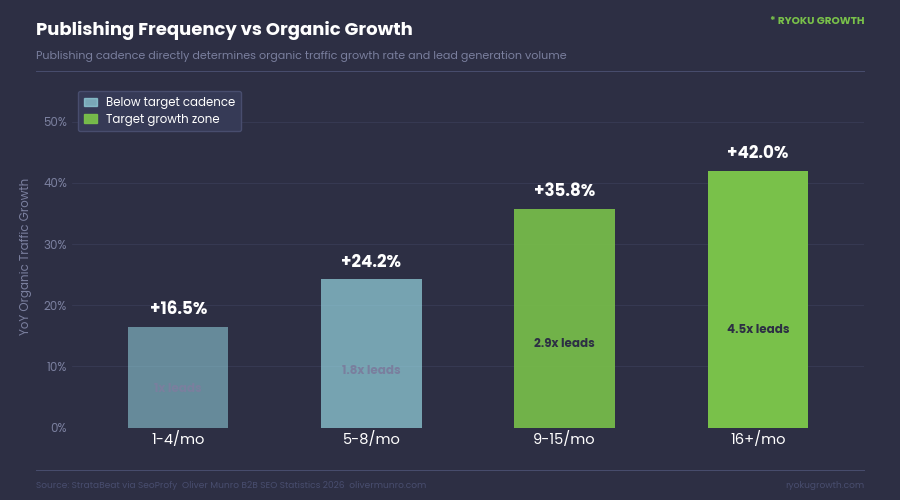
But here is the nuance most guides miss: consistency matters more than peaks. A SaaS company that publishes 4 high-quality pieces per month every month will outperform one that publishes 20 pieces one month and then goes silent for six weeks. Google rewards consistent publishing signals. Build a cadence you can actually sustain.
The E-E-A-T Imperative: Author Bylines, SME Involvement, and Sourcing
In a world where 19.56% of the top 20 Google results are now AI-generated, the companies that stand out are those that demonstrate real human expertise. This means:
- Named author bylines with verifiable credentials and author bio pages
- Subject matter expert (SME) quotes integrated into content
- Citing primary sources, not just aggregating what other blogs already say
- Updating evergreen content regularly — content updated within the last 30 days receives 3.2x more AI citations — relevant for both traditional and AI-powered search
Link Building for B2B SaaS SEO – Authority Is Still the Deciding Factor
When two SaaS companies have similarly good content and technical SEO, the one with stronger domain authority wins. Links remain the most powerful signal of authority in Google’s algorithm, and pages in the first position have 3.8 times more backlinks than those ranking lower.
But link building for B2B SaaS requires a different approach than link building for ecommerce or local businesses. Here is what actually works:
Digital PR and Original Research
The highest ROI link building strategy for SaaS is publishing original data that journalists and bloggers want to reference. When Slack published data about team communication patterns, it earned coverage from hundreds of publications without a single outreach email. When you become the source, links come to you.
Conduct surveys of your customer base. Analyze anonymized usage data. Partner with a research firm. Publish the findings with clear methodology. Distributed through a PR push. Done well, a single research report can earn 50-200 links in the first month of publication.
Strategic Partner and Integration Pages
SaaS ecosystems are built on integrations. Every technology partner you integrate with is a potential link source and often a highly authoritative one. Create co-marketing content with integration partners, get listed in their integration directories, and build dedicated integration landing pages on your own site.
Importantly, 50.6% of B2B companies using organic link building report better results compared to those using manual outreach, where only 35.3% see success. Earned links from real editorial mentions and partner relationships consistently outperform link schemes and low-quality directory submissions.
Broken Link Building and Resource Page Outreach
Find authoritative resource pages and “best tools” roundups in your category. Use tools like Ahrefs or Semrush to identify pages that link to competitors or to now-defunct resources. Reach out with a genuinely useful replacement. This is still one of the most scalable white-hat link acquisition methods available.
Thought Leadership and Contributed Articles
Encourage your founders and executives to write in publications your buyers read. B2B SaaS buyers consume industry media. A bylined article in a relevant trade publication earns a link, builds personal brand authority, and signals to Google that real experts stand behind your brand.
Adapting Your SaaS SEO Strategy for AI-Powered Search
No b2b saas seo guide written in 2026 would be complete without addressing the elephant in the room: AI is changing search behavior faster than any update in the last decade.
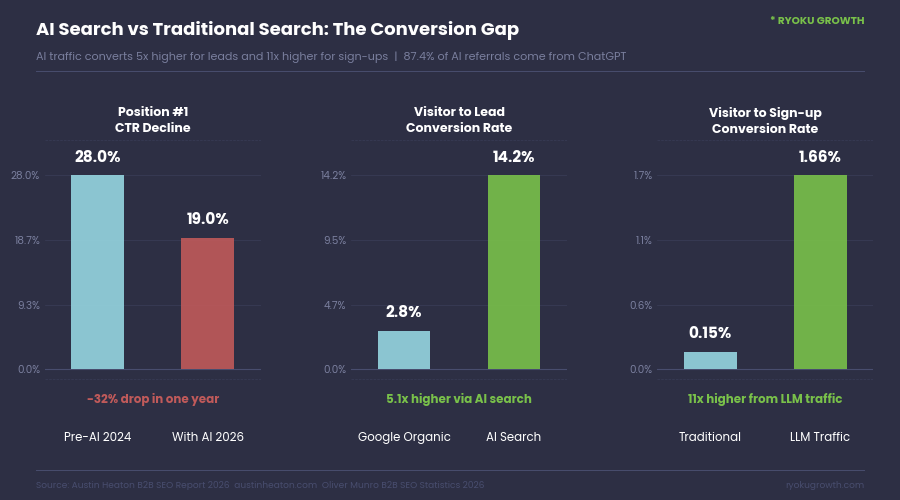
The numbers are clear and slightly alarming. AI Overviews now appear on 13.14% of all US desktop queries, double the rate from January 2025. When an AI Overview appears, click-through rates drop from 15% to just 8%. First-position organic CTR has dropped from 28% to 19% — a 32% decline in a single year. 60% of Google searches now end in zero clicks.
This could sound like terrible news for SEO. It is not; but it does require a strategic pivot.
Optimize for AI Overviews and Answer Engine Visibility
The counterintuitive reality: 46.% of AI Overview citations link to pages ranked outside the top 50 organic results. This means authority and relevance trump pure ranking position for AI inclusion. You can be cited in an AI Overview even if you are not ranking #1 for that query.
What makes Google include your content in an AI Overview? Structured, well-formatted content that directly answers questions. Proper schema markup. High E-E-A-T signals. Concise, accurate definitions and explanations within longer pieces. Essentially, writing clearly and authoritatively continues to be rewarded — the delivery mechanism just changed.
Build for Multi-Platform Discovery
AI search is not just Google’s AI Overview. 87.4% of all AI referral traffic currently comes from ChatGPT. And here is the conversion data that should get your attention: AI search traffic converts at 14.2% compared to Google’s 2.8% — and LLM visitors convert to sign-ups at 1.66% versus 0.15% from traditional search.
The implication: getting your SaaS brand mentioned in ChatGPT, Perplexity, and Gemini responses is not just a vanity metric. It is a high-conversion acquisition channel. Brands that are cited across multiple AI platforms share a common profile: strong domain authority (sites with 32,000+ referring domains are 3.5x more likely to be cited by ChatGPT), fresh and frequently updated content, and comprehensive schema markup.
Zero-Click Doesn’t Mean Zero Value
With 60% of searches ending without a click, the goal shifts from “get the click” to “own the impression.” Brand mentions in featured snippets, AI Overviews, and “People Also Ask” boxes build awareness even without a click. Over time, this brand familiarity increases direct search volume for your brand name — which is the highest-converting traffic of all.
The practical takeaway: include clear, quotable answers to key questions within your content, even inside longer articles. A two-sentence definition that Google can pull into a featured snippet or AI Overview is more valuable than a two-paragraph explanation that it cannot.
Measuring What Actually Matters in B2B SaaS SEO
Most SaaS companies measure the wrong things and draw the wrong conclusions. Ranking reports feel good. Traffic dashboards look impressive. But neither of these tells you whether your SEO program is actually generating pipeline and revenue.
The Metrics Hierarchy for SaaS SEO
Tier 1 – Business Outcomes (Report to Leadership)
- Organic-attributed MRR and pipeline
- Organic trial/demo conversion rate (industry benchmark: 8.5% of organic visitors start a free trial)
- Organic close rate (SEO leads close at 14.6% vs. 1.7% for outbound)
- Customer Acquisition Cost (CAC) from organic vs. paid
Tier 2 – Channel Performance (Report to Marketing Team)
- Organic sessions by content type (awareness vs. consideration vs. decision)
- Organic conversion rate by landing page
- Share of Voice on target keyword clusters
- Branded vs. non-branded organic traffic ratio
Tier 3 – SEO Health Indicators (Report to SEO/Content Team)
- Core Web Vitals scores across key page templates
- Crawl coverage and indexation rate
- Backlink velocity and domain rating progression
- Average position movement for priority keyword clusters
The critical insight: SEO should always be measured over a 12-month minimum window. Break-even for a SaaS SEO program typically hits at month 7, and full ROI materializes over 2-3 years as content compounds. Judging SEO at 90 days is like judging a garden 2 weeks after planting seeds.
The B2B SaaS SEO Roadmap – What to Do in What Order
After a decade of building organic programs, I can tell you that the sequence matters as much as the strategy. Here is the order I would recommend for a SaaS company starting or resetting its SEO program in 2026:
Months 1–2: Foundation
Run a full technical SEO audit. Fix crawlability, indexation, site speed, and canonical issues. Identify your top 20 existing pages with ranking potential and optimize them first. Quick wins on existing content consistently outperform new content in the early months.
Months 2–4: Architecture
Build your topic cluster map. Identify 3-5 core clusters aligned to your ICP’s top pain points. Create or refine your pillar pages. Establish your internal linking structure. Launch your keyword-mapped content calendar.
Months 4–8: Velocity
Publish consistently within your established clusters. Prioritize comparison and alternative pages — they generate pipeline fastest. Launch your first original research project. Begin systematic link building through partner pages and PR.
Months 8–12: Authority
With a content library now in place, shift more effort toward authority building: digital PR, high-quality contributed articles, co-marketing with integration partners. Begin testing AI-search optimization: add FAQ schema, update high-priority pages monthly, ensure comprehensive coverage of your core topics.
Month 12+: Compounding
Now you have data. Double down on content formats and clusters that are actually converting. Prune or consolidate thin content that is diluting crawl budget. Expand into adjacent keyword territories. Your organic program at month 12 should require less marginal effort per incremental traffic gain — that is the compounding effect at work.
The Bottom Line: Organic Is Your Most Durable Competitive Advantage
Here is what I have learned from watching the best SaaS companies in the world use organic search to scale: SEO is not a marketing tactic. It is infrastructure. It is the system that ensures your best-fit buyers can find you, learn from you, and trust you before they ever see a sales pitch.
The companies that win in their categories are almost always the ones that started building this infrastructure before they needed it. Salesforce did not become the dominant brand in CRM search overnight. Slack did not rank #1 for team communication tools in its first month. These wins were built through years of consistent publishing, technical excellence, and genuine authority earned through content that actually helped buyers do their jobs.
The data in 2026 makes the strategic case better than any anecdote: 702% ROI. 53% of SaaS traffic from organic. 14.6% organic lead close rate. 44.6% of B2B revenue from organic search.
The SaaS companies investing seriously in SEO today are building an asset that will compound for years. Those ignoring it are renting attention through paid channels that stop the moment the invoice stops.
This saas seo guide is your starting point. The competitive advantage is built in the execution.