
Industry: Heavy Equipment / Construction Machinery
Market: North America
Service: Go-to-Market (GTM) Strategy, Market Segmentation, Positioning, Demand Generation Strategy
Focus: Used Heavy Equipment
Executive Summary
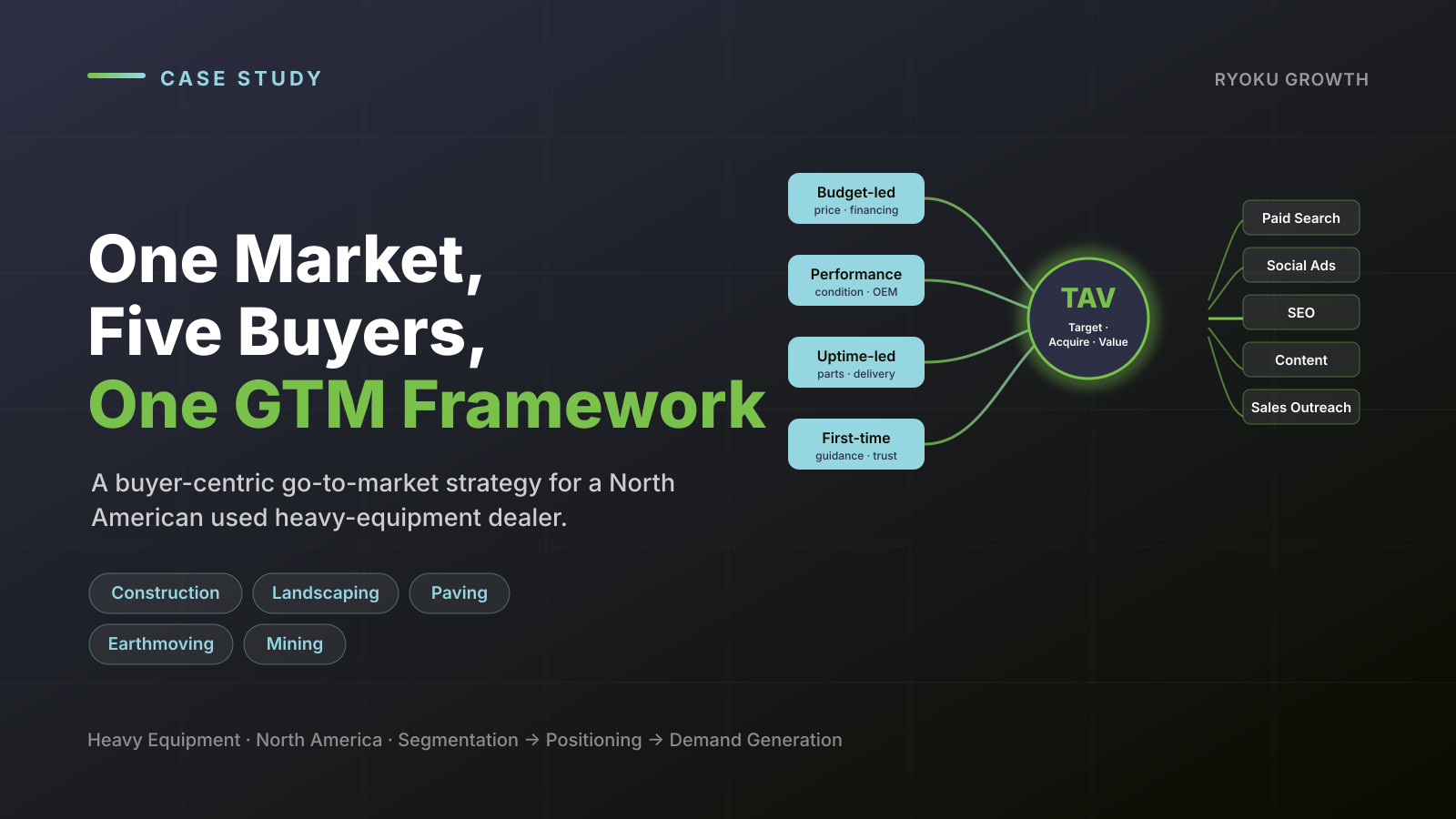
A leading North American heavy equipment dealer with an extensive portfolio of used machinery needed a more structured go-to-market strategy to reach diverse buyer segments across the construction, landscaping, paving, earthmoving, and mining industries.
The challenge was not simply generating more demand. Different buyers evaluated used equipment based on different purchasing priorities. While budget-conscious customers focused on affordability and financing, performance-oriented buyers prioritized equipment condition and OEM backing. Operators with time-sensitive projects needed confidence in inspections, parts availability, and delivery reliability.
Ryoku Growth developed a buyer-centric GTM framework to address these differences. The strategy combined a Target-Acquisition-Value (TAV) matrix, industry-specific positioning, and an integrated acquisition approach spanning paid search, social advertising, SEO, content marketing, and sales outreach.
The resulting framework connected customer segmentation with messaging, channel recommendations, and content priorities, providing a structured approach to reaching relevant equipment buyers.
Key Results
- 24% increase in qualified equipment inquiries through more relevant audience targeting and messaging.
- 19% improvement in landing-page conversion rate through segment-specific content and calls to action.
- 16% reduction in cost per qualified lead through improved targeting and channel optimization.
- 21% increase in engagement with priority equipment listings through stronger campaign-to-inventory alignment.
About the Client
The client is a leading North American heavy equipment dealer with an extensive portfolio of used machinery serving businesses across multiple industrial sectors.
Its target customers include construction contractors, fleet managers, landscaping businesses, earthmoving operators, paving companies, and mining organizations.
These businesses purchase used heavy equipment for different operational and financial reasons. Some prioritize reducing capital expenditure, while others focus on equipment performance, operational reliability, availability, and the ability to meet project timelines.
With a diverse used machinery portfolio and multiple buyer segments to serve, the business needed a go-to-market approach that could communicate the right value proposition to the right audience.
A standardized marketing message was unlikely to address the distinct purchasing considerations of every customer group. The opportunity was to build a more focused acquisition strategy around industry requirements, buyer motivations, and equipment purchasing behavior.
The Client Problem: Generic Marketing Was Not Addressing Diverse Buyer Needs
The business needed a scalable go-to-market strategy for its used equipment portfolio. However, its broad audience presented a significant marketing challenge.
Different customer segments approached used equipment purchases with different expectations, evaluation criteria, and operational priorities.
1. Different Buyers Had Different Purchasing Motivations
The used heavy equipment market includes buyers with distinct financial, operational, and performance requirements.
For example:
- Budget-conscious buyers prioritized competitive pricing, affordability, and financing options.
- Performance-oriented buyers needed confidence in equipment condition, reliability, and OEM backing.
- Downtime-sensitive operators valued inspection quality, parts availability, dependable delivery, and equipment readiness.
- First-time buyers needed additional product education, guidance, and confidence throughout the purchasing process.
Without a clear understanding of these differences, marketing messages risked being too generic to resonate with individual buyer groups.
2. Industry Requirements Were Not Uniform
Construction contractors, landscaping businesses, paving companies, earthmoving operators, and mining organizations use equipment in different operating environments.
Their purchasing considerations vary based on project requirements, equipment utilization, operating conditions, and financial constraints.
A message that resonates with a construction contractor may not necessarily address the priorities of a mining operator or landscaping business.
This created a need for industry-specific positioning that connected available equipment with the practical requirements of each market segment.
3. Marketing Needed Better Alignment With Buyer Intent
Generating website traffic or advertising engagement alone would not address the underlying challenge.
The business needed a strategy that connected audience targeting, equipment inventory, messaging, and acquisition channels to the actual purchasing motivations of potential customers.
Without this alignment, marketing activity risked attracting less relevant visitors and generating inquiries that were not sufficiently qualified.
The Business Objective
The objective was to develop a scalable GTM framework that could:
- Identify and prioritize relevant buyer segments.
- Align equipment positioning with industry-specific requirements.
- Develop messaging around distinct purchasing motivations.
- Connect acquisition channels with buyer intent and equipment availability.
- Improve the relevance of equipment inquiries and marketing engagement.
- Establish a repeatable approach to demand generation across multiple industries.
Ryoku Growth approached the challenge by placing buyer segmentation and value proposition alignment at the center of the GTM strategy.
The Solution: A Buyer-Centric Go-to-Market Framework
Ryoku Growth developed an integrated GTM framework built around three strategic pillars: market and buyer segmentation, industry-specific positioning, and coordinated demand generation.
The approach was designed to translate customer insights into actionable marketing priorities rather than relying on broad audience targeting and generic equipment messaging.
1. Target-Acquisition-Value (TAV) Matrix
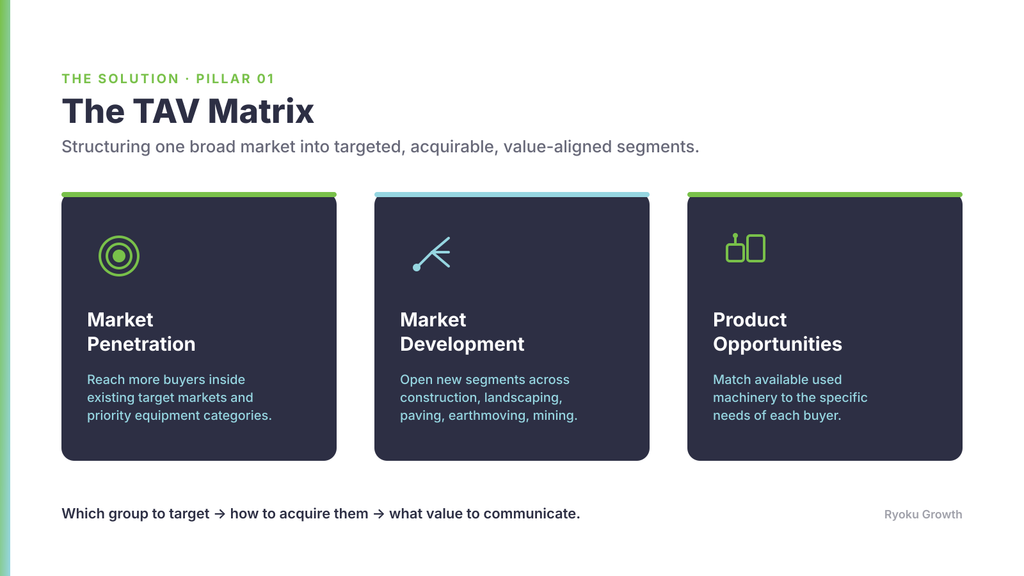
The first pillar focused on structuring the market opportunity through a Target-Acquisition-Value (TAV) matrix.
The framework helped connect market opportunities with relevant buyer segments, acquisition priorities, and the value propositions most likely to resonate with each audience.
It considered three strategic dimensions:
Market Penetration
Identifying opportunities to reach more buyers within existing target markets and improve engagement with relevant equipment categories.
Market Development
Exploring opportunities to reach additional customer segments and industries, including construction, landscaping, paving, earthmoving, and mining.
Product-Related Opportunities
Connecting the available used machinery portfolio with specific customer requirements and identifying opportunities to improve how equipment offerings were positioned to potential buyers.
The TAV matrix provided a structured way to evaluate opportunities and translate buyer insights into segment-level acquisition priorities.
Rather than approaching the entire market as one audience, the strategy considered which customer groups to target, how to acquire their attention, and what value proposition to communicate.
2. Industry-Specific Positioning and Messaging
The second pillar focused on developing more relevant messaging for different industries.
Ryoku Growth aligned equipment positioning with the operational requirements and purchasing considerations of each audience.
The strategy considered the distinct needs of:
- Construction: Equipment availability, project requirements, productivity, and cost efficiency.
- Landscaping: Equipment suitability, versatility, and affordability for landscaping operations.
- Paving: Equipment performance, operational reliability, and project readiness.
- Earthmoving: Equipment capability, durability, and suitability for demanding site conditions.
- Mining: Operational reliability, equipment condition, and minimizing potential downtime.
This industry-focused approach helped shift the messaging from simply promoting used machinery to communicating how the available equipment could address specific business and operational requirements.
It also provided direction for developing relevant campaign themes, landing-page messaging, and supporting content.
3. Integrated Acquisition and Demand Generation Strategy
The third pillar focused on connecting the GTM strategy with the channels used to reach and engage potential equipment buyers.
Ryoku Growth aligned paid search, social advertising, SEO, content marketing, and sales outreach around the buyer segments and their corresponding value propositions.
Paid Search
Focused on reaching buyers actively researching used heavy equipment and relevant machinery categories through search-based acquisition opportunities.
Social Advertising
Supported targeted audience engagement through messaging aligned with industry requirements and purchasing motivations.
SEO
Provided a foundation for improving organic discoverability across relevant equipment categories, industry-related searches, and buyer research queries.
Content Marketing
Supported the education and evaluation process through content aligned with equipment requirements, buyer concerns, and industry-specific applications.
Sales Outreach
Connected marketing insights with sales engagement, providing direction for communicating relevant equipment value propositions to prospective buyers.
The objective was to create consistency across acquisition channels so that buyers encountered messaging aligned with their requirements throughout the evaluation process.
4. Translating Strategy Into Actionable Marketing Priorities
The final component focused on turning the GTM framework into practical recommendations for execution.
The segmentation insights and industry-specific positioning informed:
- Campaign themes for different buyer groups.
- Channel recommendations based on acquisition opportunities.
- Content priorities aligned with buyer needs.
- Segment-specific value propositions.
- Landing-page messaging and calls to action.
- Better alignment between promotional campaigns and available equipment listings.
This created a structured connection between market understanding, marketing execution, and the equipment portfolio.
Instead of relying on a single marketing message, the business had a framework for communicating different value propositions to different audiences.
The Results: A More Structured Approach to Demand Generation
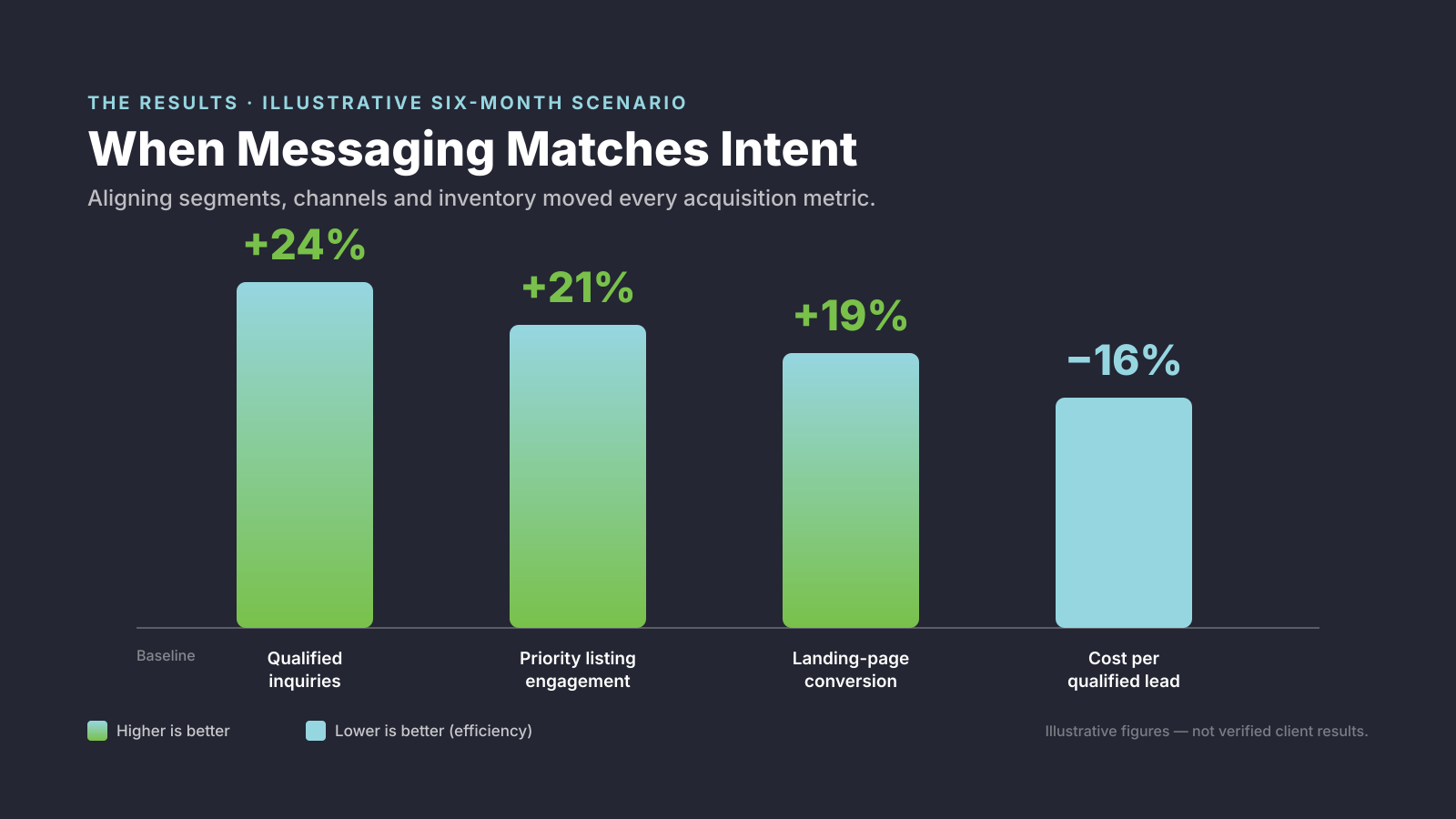
The GTM framework established a strategic foundation for improving the relevance of marketing campaigns and aligning acquisition efforts with buyer requirements.
The following figures represent an illustrative six-month performance scenario, not verified client results.
1. Increase in Qualified Equipment Inquiries
24% increase
More relevant audience targeting and segment-specific messaging were associated with an illustrative 24% increase in qualified equipment inquiries.
The approach focused on connecting buyer motivations with relevant equipment offerings, helping make acquisition efforts more aligned with prospective customers’ needs.
2. Improvement in Landing-Page Conversion Rates
19% improvement
Industry-specific messaging and more relevant calls to action contributed to an illustrative 19% improvement in landing-page conversion rates.
The objective was to create a closer connection between campaign messaging, buyer expectations, and the information presented on landing pages.
3. Reduction in Cost per Qualified Lead
16% reduction
The illustrative scenario showed a 16% reduction in cost per qualified lead through improved targeting and channel optimization.
By aligning acquisition efforts with more relevant buyer segments, the strategy aimed to improve marketing efficiency and reduce investment in less relevant audience segments.
4. Higher Engagement With Priority Equipment Listings
21% increase
Better alignment between campaigns and available equipment listings contributed to an illustrative 21% increase in engagement with priority inventory.
This reinforced the importance of connecting marketing activity with actual equipment availability and the specific requirements of prospective buyers.
Summary of Illustrative Outcomes
| Performance metric | Illustrative six-month outcome |
|---|---|
| Qualified equipment inquiries | +24% |
| Landing-page conversion rate | +19% |
| Cost per qualified lead | -16% |
| Engagement with priority listings | +21% |
These figures illustrate the intended performance scenario and should not be presented as actual client outcomes without supporting measurement data.
Overall Business Impact
Beyond the illustrative performance indicators, the engagement established a repeatable go-to-market framework that connected customer segmentation, industry-specific positioning, acquisition channels, and equipment inventory.
The framework provided a more structured foundation for reaching diverse buyer groups and aligning marketing activity with their purchasing priorities.
For a business operating across multiple heavy equipment categories and industries, this approach created a clearer path toward more relevant demand generation.
Key Takeaways: What Heavy Equipment Businesses Can Learn From This GTM Strategy
1. One Marketing Message Cannot Address Every Equipment Buyer
Used equipment buyers evaluate purchases based on different financial and operational considerations.
Understanding these differences allows businesses to develop more relevant messaging and improve the alignment between their equipment offerings and customer expectations.
2. Industry-Specific Positioning Makes Equipment Marketing More Relevant
Construction, landscaping, paving, earthmoving, and mining businesses have different equipment requirements.
Positioning equipment around industry-specific applications and operational challenges can create stronger connections between the offering and the intended buyer.
3. Buyer Segmentation Should Guide Acquisition Strategy
Segmentation should influence more than audience selection.
It should also shape campaign messaging, channel recommendations, content priorities, landing pages, and sales outreach.
The TAV framework provides a structured way to connect market opportunities with acquisition and value proposition decisions.
4. Marketing and Inventory Need to Work Together
For heavy equipment dealers, acquisition campaigns should reflect the equipment actually available.
Aligning campaign themes with priority inventory helps create a more relevant experience for prospective buyers and supports more focused demand generation.
5. GTM Strategy Should Connect Planning With Execution
A go-to-market strategy is most useful when it translates market insights into practical marketing decisions.
Connecting segmentation, positioning, acquisition channels, and content priorities provides a more repeatable framework for reaching target audiences and supporting business growth.