Industry: Dental SaaS / Cloud Dental Software
Market: United States
Engagement duration: 2 years
Services: Technical SEO, On-Page SEO, Off-Page SEO, Content Marketing, Generative Engine Optimization (GEO)
Executive Summary
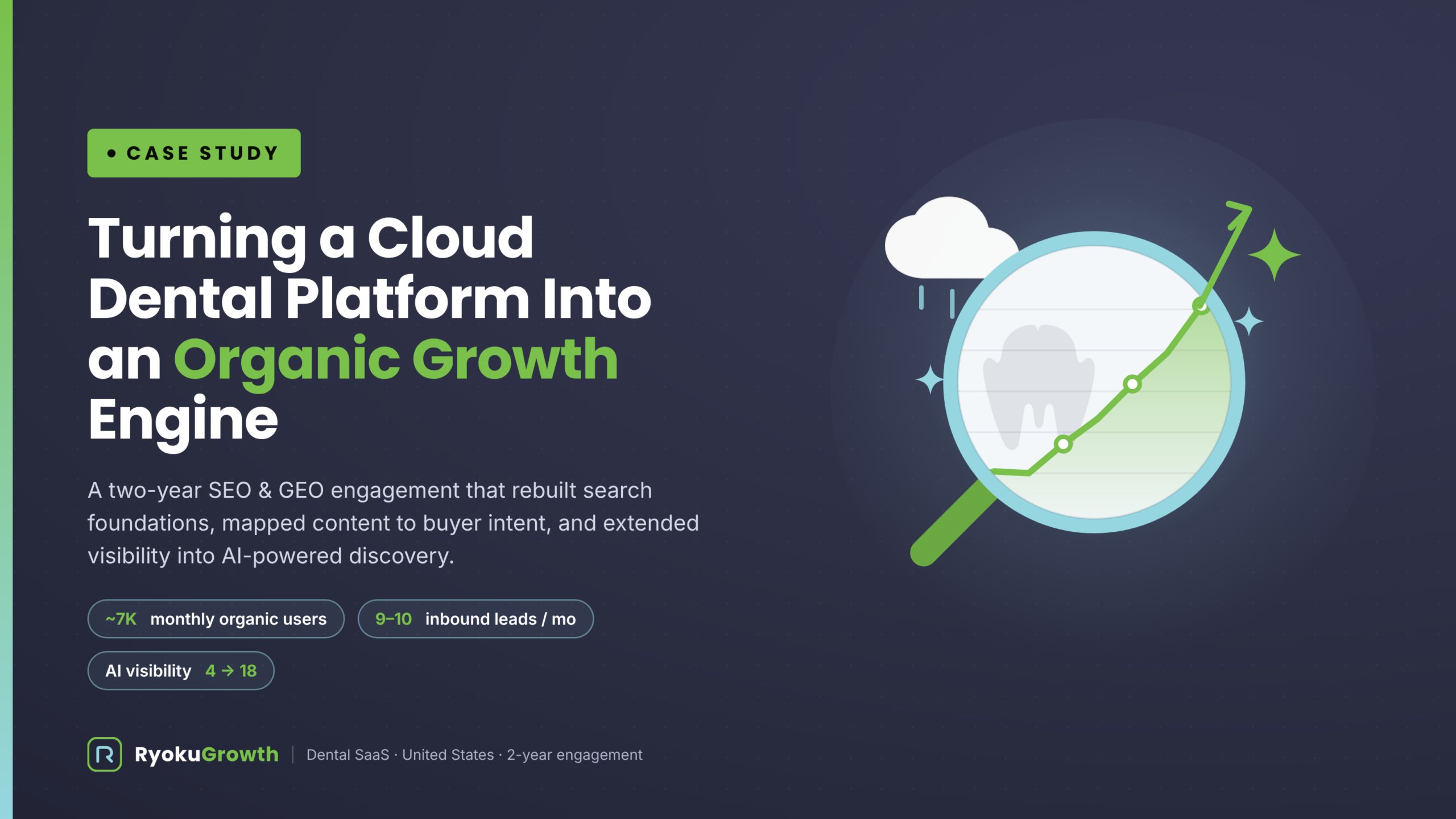
A cloud dental software company targeting independent dentists and small-to-medium-sized dental practices in the United States needed a more effective way to reach potential customers through organic search.
Following a new website launch, the company had lost continuity in its previous SEO efforts. Its organic visibility was limited, commercial keywords were largely ranking on page two, and the website generated approximately 400 Google Search Console clicks per month with almost no inbound leads.
Ryoku Growth partnered with the company over a two-year period to establish a comprehensive SEO and GEO strategy. The engagement combined technical SEO, website architecture improvements, buyer-intent keyword research, original product-led content, digital PR, guest outreach, and AI search optimization.
Rather than producing content based on assumptions, Ryoku Growth worked closely with the client’s product team to understand its dental software capabilities and translate that knowledge into original, search-focused content.
Key Results
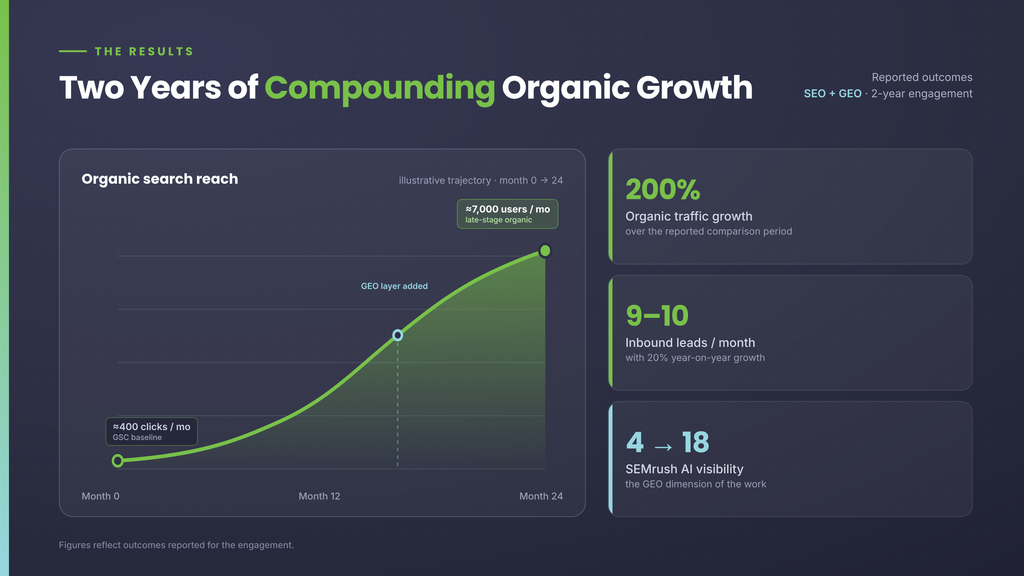
- Approximately 7,000 monthly users: Reported organic search traffic at the later stage of the engagement.
- 200% reported traffic growth: Improvement in organic traffic over the reported comparison period.
- 9–10 inbound leads per month: Reported monthly lead generation, with 20% year-on-year growth.
- 20% improvement in SEMrush visibility: Achieved during the first six months, followed by continued keyword expansion.
- AI Visibility increased from 4 to 18: Reported improvement in SEMrush’s AI visibility metric.
The engagement established a more structured approach to organic acquisition, connecting technical SEO, original content, search intent, and AI search visibility to the company’s growth objectives.
About the Client
The client is a cloud dental software company serving dental professionals and practices in the United States.
Its technology supports the operational needs of dental practices, making it relevant to independent dentists and practices operating across multiple locations. The company’s target audience included solo practitioners and dental offices with up to five locations.
In a competitive dental software market, reaching these buyers requires more than ranking for broad industry terms. Prospective customers research software categories, compare solutions, evaluate product features, and look for platforms that align with their practice’s operational requirements.
Organic search presented an opportunity to reach these prospects at different stages of the buying journey.
However, to capitalize on that opportunity, the company needed a more structured SEO strategy built around its product capabilities, the questions its buyers were asking, and the commercial searches that could influence software purchasing decisions.
The Challenge: Limited Organic Visibility and Almost No Inbound Leads
When Ryoku Growth began working with the company, its website was not generating meaningful inbound demand through organic search.
The business faced several interconnected challenges.
1. SEO continuity had been disrupted after a website launch
The company had recently launched a new website but had not maintained continuity in its previous SEO work.
This created a need to reassess the website’s search performance, address structural limitations, and establish a sustainable optimization strategy.
A new website launch can affect existing search visibility when architecture, internal linking, URLs, and other SEO considerations are not managed consistently. The priority was to establish a stronger foundation for continued organic growth.
2. Commercial keyword visibility was limited
The website had some visibility for terms related to cloud dental EHR software, but important business-related keywords were generally ranking on page two.
This limited the company’s ability to compete for searches related to dental software, cloud dental software, and dental practice management software.
The competitive landscape included established platforms such as Curve Dental, Dentrix Ascend, and Open Dental.
To compete effectively, the company needed to expand its visibility beyond a narrow set of existing rankings and address the broader range of queries used by dental professionals researching software solutions.
3. Content production lacked a research-led strategy
Existing content had largely been developed based on assumptions rather than systematic keyword research and search intent analysis.
Content topics were not sufficiently mapped to the questions potential buyers asked, the products they evaluated, or their stage in the purchasing journey.
This created an opportunity to build a content strategy that balanced informational discovery with commercial evaluation and product-specific search demand.
4. The website needed a stronger SEO foundation
Site architecture and internal linking were among the areas requiring attention. The engagement called for a comprehensive approach across technical SEO, on-page optimization, and off-page authority building.
At the same time, the company operated in a competitive market with limited domain authority, making sustained content development and authority-building activities important to its long-term organic growth strategy.
The Business Objective
The objective was to establish a sustainable organic acquisition channel that could:
- Improve visibility for relevant dental software searches in the US market.
- Reach independent dentists and small dental practices.
- Build visibility across informational and commercial search intent.
- Increase inbound lead generation through organic search.
- Strengthen the company’s visibility across emerging AI-powered search experiences.
Ryoku Growth approached the engagement as a long-term organic growth initiative rather than a series of isolated SEO tasks.
The Solution: A Comprehensive SEO and GEO Strategy
Ryoku Growth implemented an integrated strategy covering technical SEO, on-page SEO, off-page SEO, original content production, and Generative Engine Optimization.
The work was guided by a central principle: search visibility should be built around the client’s actual product capabilities and the needs of its target buyers.
1. Technical SEO and Website Architecture
The first workstream focused on establishing a stronger technical and structural foundation for organic growth.
Ryoku Growth addressed technical SEO and website optimization across the engagement, with particular attention to site architecture and internal linking.
The approach included:
- Reviewing the website’s technical SEO and structural setup.
- Improving site architecture and internal linking to support better content discovery.
- Optimizing on-page elements across relevant website pages.
- Addressing technical and on-page SEO requirements as part of an ongoing optimization process.
- Supporting a more organized structure for product, feature, and supporting content.
The objective was to make the website easier for search engines to discover and understand while creating clearer connections between related topics, product capabilities, and buyer needs.
Technical SEO was treated as an ongoing workstream, supporting the content and authority-building activities that followed.
2. Competitor Gap Analysis and Buyer-Intent Keyword Research
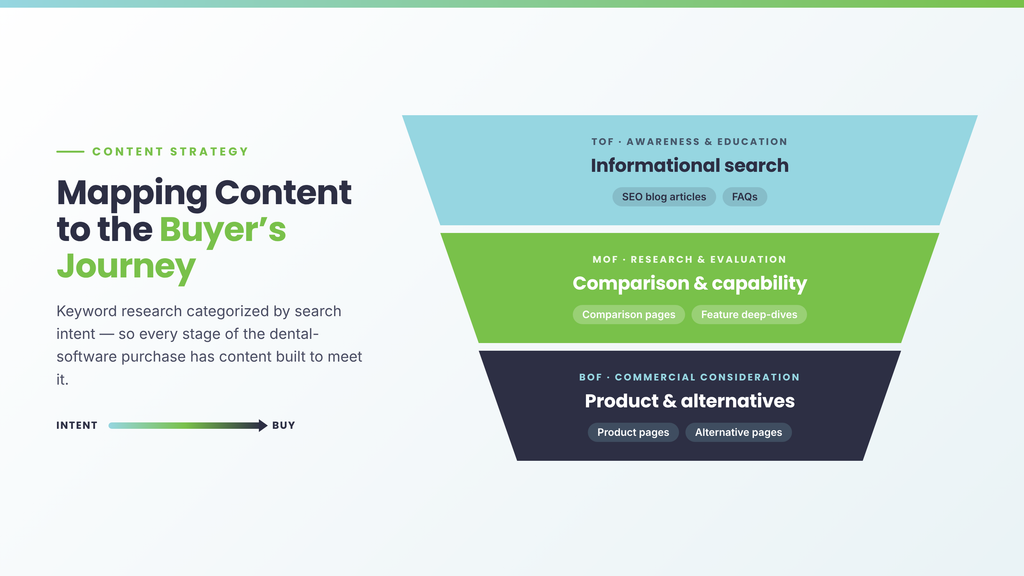
Instead of selecting keywords based only on search volume, Ryoku Growth conducted competitor gap analysis and research into buyer intent.
The strategy considered the queries prospective customers used when researching dental software and the different stages they moved through before evaluating a solution.
Keywords were categorized across the top, middle, and bottom of the funnel.
Top of funnel (TOF): Awareness and education
Content targeted informational queries used by dental professionals exploring software categories, understanding their requirements, or researching operational challenges.
Middle of funnel (MOF): Research and evaluation
Content supported prospects comparing software capabilities, understanding different approaches, and evaluating potential solutions.
Bottom of funnel (BOF): Commercial consideration
Content targeted more commercially oriented searches associated with dental software categories, product features, comparisons, and alternatives.
This framework helped create a more deliberate connection between keyword research, content planning, and the purchasing journey.
It also reduced reliance on intuition-led content production by establishing a research-led process for identifying relevant topics and prioritizing opportunities.
3. Original, Product-Led Content Production
Original content production was a central component of the engagement.
Ryoku Growth held regular meetings with the client’s product team to understand its technology, product capabilities, and the specific problems the software was designed to address.
Information gathered during these discussions was carefully incorporated into the content development process. The objective was to produce original material grounded in the client’s actual dental software expertise rather than generic content about the industry.
The content strategy covered several formats.
SEO blog articles
Educational content addressed informational searches and helped expand the website’s coverage of topics relevant to dental professionals.
Product and feature pages
Product-focused content communicated the software’s capabilities and created relevant entry points for prospects researching specific functionality.
Comparison pages
Comparison content supported buyers evaluating dental software options and researching differences between potential solutions.
Alternative pages
Alternative-focused content addressed prospects exploring alternatives to established dental software platforms.
FAQs
Question-led content addressed specific queries related to dental software and its capabilities, supporting clearer communication of product information.
Across these formats, content was developed with search intent and product relevance in mind.
The client’s existing technology and product knowledge provided the subject matter. Ryoku Growth’s role was to translate that knowledge into original, search-focused content aligned with relevant keyword opportunities and the needs of the target audience.
This approach helped connect the client’s product expertise with the information prospective buyers were actively seeking.
4. Off-Page SEO Through Digital PR and Guest Outreach
With limited domain authority and established competitors in the market, the company also needed an approach to strengthening its off-page SEO.
Ryoku Growth implemented digital PR and guest outreach as part of the broader organic growth strategy.
These activities supported the company’s efforts to improve organic visibility and build a stronger search presence over time.
The off-page work complemented technical SEO and content production rather than operating independently. The goal was to support a more comprehensive SEO strategy in which website quality, relevant content, and external authority-building efforts worked together.
The engagement also saw improvements in branded search visibility and domain authority, although specific backlink counts and domain authority changes should be added only after validation against historical reports.
5. Generative Engine Optimization (GEO)
Alongside traditional SEO, Ryoku Growth incorporated GEO into the engagement.
As AI-powered search experiences became increasingly relevant to how people discover and evaluate information, the strategy extended beyond conventional keyword rankings to include AI search visibility.
GEO was integrated with the broader content and optimization work, with the aim of strengthening the website’s discoverability and the clarity of its product-related information across search experiences.
The reported SEMrush AI Visibility metric increased from 4 to 18 during the engagement.
This represented a positive change in the tracked AI visibility metric. The exact interpretation depends on the SEMrush report definition and tracked platforms, so the final published claim should be supported by the relevant historical report.
The GEO work formed part of the broader strategy to build search visibility across both traditional search engines and emerging AI-powered discovery experiences.
6. Continuous Measurement and Optimization
The engagement continued over two years, allowing Ryoku Growth to work across technical optimization, content development, keyword expansion, and off-page activities.
Google Search Console, Google Analytics 4, and SEMrush were used as part of the measurement and optimization process.
Performance insights informed continued efforts to expand keyword coverage and strengthen organic visibility.
Rather than treating the initial improvements as the end of the project, the strategy continued to build on existing search performance and identify additional opportunities for growth.
This sustained approach was particularly relevant in a competitive SaaS market, where organic visibility depends on ongoing improvements in relevance, content coverage, technical quality, and authority.
The Results: Improved Organic Visibility and Inbound Lead Generation
Over the two-year engagement, the company reported improvements across organic traffic, keyword visibility, inbound lead generation, and AI search visibility.
1. Organic Search Traffic Reached Approximately 7,000 Monthly Users
The reported organic search audience reached approximately 7,000 users per month at the later stage of the engagement.
The initial baseline was approximately 400 Google Search Console clicks per month.
These figures indicate a substantial expansion in reported organic search reach. However, Google Search Console clicks and Google Analytics users are different metrics and should not be compared directly as a growth calculation. A consistent before-and-after comparison should be added using the same source and metric.
The engagement also recorded a reported 200% increase in organic traffic over a separate comparison period, which should be identified explicitly before publication.
2. Search Visibility Improved During the First Six Months
SEMrush visibility improved by a reported 20% during the first six months.
The company subsequently continued to gain visibility for additional keywords, expanding its presence across relevant dental software searches.
Key target topics included:
- Dental software
- Cloud dental software
- Dental practice management software
- Other relevant commercial dental software queries
The strategy focused on expanding beyond existing rankings and building coverage across informational, comparative, and commercially oriented searches.
This aligned keyword expansion with the broader objective of reaching potential customers throughout the buying journey.
3. Organic Inbound Lead Generation Reached 9–10 Leads Per Month
The company reported generating approximately 9–10 inbound leads per month, alongside 20% year-on-year lead growth.
GA4 organic conversion data and CRM information were available to assess lead generation and lead quality.
This is an important distinction from traffic growth alone. The engagement was intended to strengthen the company’s ability to attract relevant prospects, not simply increase website visits.
The reported lead outcomes suggest progress toward establishing organic search as a meaningful inbound acquisition channel. The final published version should specify whether the 9–10 leads represent all inbound leads or leads attributed specifically to organic search.
4. AI Visibility Increased From 4 to 18
The reported SEMrush AI Visibility metric increased from 4 to 18.
This improvement indicated greater visibility within the AI-search measurement being tracked during the engagement.
The result adds an AI-search dimension to the case study, demonstrating that GEO formed part of the broader optimization strategy alongside traditional SEO.
The final publication should identify the metric definition, reporting period, and platforms included in the SEMrush tracking setup.
5. Branded Search Visibility and Domain Authority Improved
The engagement also recorded improvements in branded search visibility and domain authority.
These outcomes complemented the work undertaken across digital PR, guest outreach, content development, and technical SEO.
Specific numerical improvements were not available for these metrics at the time of writing, so they should remain qualitative until supported by historical reports.
Summary of Reported Outcomes
| Performance area | Reported outcome |
| Organic search audience | Approximately 7,000 users per month |
| Traffic growth | 200% reported growth over a comparison period |
| Initial organic search baseline | Approximately 400 GSC clicks per month |
| SEMrush visibility | 20% improvement in the first six months |
| Inbound leads | Approximately 9–10 per month |
| Lead growth | 20% year-on-year |
| SEMrush AI Visibility | Increased from 4 to 18 |
| Other improvements | Branded search visibility and domain authority |
Key Takeaways: What B2B SaaS Companies Can Learn From This Engagement
1. Organic growth requires more than technical optimization
Technical SEO creates a foundation, but it needs to work alongside keyword strategy, useful content, and authority building.
For a SaaS company competing in an established market, improvements across these areas can support a more comprehensive organic growth strategy.
2. Product expertise can be a competitive advantage in SEO
Generic content can cover broad industry topics, but it may not communicate what makes a particular software product relevant to its target audience.
By working closely with the client’s product team, Ryoku Growth could incorporate actual product knowledge into original content.
For niche B2B SaaS companies, this approach can help connect content with real use cases, product capabilities, and buyer questions.
3. Keyword research should account for the entire buying journey
Prospective customers do not rely exclusively on transactional queries when choosing software.
They research problems, learn about possible solutions, compare products, and evaluate features before making a decision.
Mapping content across TOF, MOF, and BOF creates opportunities to address these different needs while connecting informational discovery with commercial evaluation.
4. SEO and GEO can be addressed through a coordinated strategy
Traditional search visibility and AI-powered discovery are different measurement areas, but they can be considered within a coordinated organic strategy.
Content quality, clear product information, and a technically sound website support the broader objective of making a business’s expertise discoverable.
AI visibility should be tracked separately and reported using clearly defined metrics rather than assumed from traditional keyword rankings.
5. Sustainable growth requires continuous optimization
A two-year engagement provides scope to move beyond initial technical improvements and build a continuing process of content expansion, keyword discovery, and performance analysis.
For B2B SaaS businesses in competitive markets, sustained optimization can be important to expanding organic reach and creating opportunities for inbound demand generation and this can be easily driven by a custom B2B SAAS SEO Plan.