

A strong product does not guarantee revenue. Many B2B companies invest months building features, hiring teams, and refining positioning, only to struggle at launch. Around 35 percent of startups fail because there is no market need for their product, highlighting how critical go to market strategy and validation are, according to the CB Insights startup failure report.
The issue is rarely the product. It is the strategy behind how that product reaches the market.
This is where go to market strategy examples become valuable. They show what works in real scenarios, how companies approach distribution, and how they align sales, marketing, and product for predictable growth.
Key Takeaways
- A go-to-market strategy connects product value to the right audience and channel
- Successful companies focus on clarity, not complexity
- Real world examples reveal patterns you can apply immediately
- Execution matters more than planning
- Alignment across teams drives consistent revenue growth
What Is a Go-To-Market Strategy
A go-to-market strategy is a structured plan that defines how a company brings a product to market and drives customer acquisition. It is not a marketing plan. It is a cross-functional strategy that coordinates product, marketing, sales, customer success, and sometimes partnerships around a common objective.
It answers a specific set of questions:
- Who is the ideal customer, and what does their buying process look like?
- What problem does the product solve, and how acutely does the customer feel it?
- How will the product reach the customer, and through which channels?
- What messaging will resonate at each stage of the buying journey?
- What motion, product-led, sales-led, or hybrid, fits the deal size and complexity?
Geoffrey Moore, author of Crossing the Chasm, put it plainly:
In a customer-led world, Go-To-Market is the strategy. Without it, product launches become hope-based exercises.
A GTM strategy bridges the gap between product-market fit and scalable revenue. It is the difference between a company that grows predictably and one that restarts every quarter.
Why Go-To-Market Strategy Examples Matter
Reading theory helps, but real examples provide clarity. They show how companies:
- Prioritise specific customer segments
- Choose between product led, sales led, or hybrid models
- Structure pricing and packaging
- Scale distribution channels
Most importantly, they reveal that there is no single “perfect” strategy. The best approach depends on the product, market, and stage of growth.
Key Benefits of Studying Go-To-Market Strategy Examples
Most B2B teams don’t fail because they built the wrong product. They fail because they assumed the market would figure out the value on its own. Studying real go-to-market strategy examples closes that gap by showing you what deliberate, well-executed market entry actually looks like.
1. Faster Decision Making
When you’re choosing between a product-led and sales-led approach, theory only gets you so far. Seeing how Slack scaled through frictionless onboarding or how Salesforce built revenue through high-touch enterprise relationships gives you a concrete reference point. Examples reduce guesswork and help teams move with confidence.
2. Better Market Positioning
Positioning is about making your ideal customer feel like your product was built specifically for them. Examples show you how companies like HubSpot carved out authority in crowded markets not by outspending competitors, but by educating their audience before ever asking for a sale.
3. Improved Resource Allocation
Early-stage teams often spread budget and effort across too many channels at once. Real examples reveal where companies concentrated their energy, which channels they prioritised at which stage, and when they chose to scale. That context saves you from expensive experiments with predictable outcomes.
4. Reduced Risk
The most costly go-to-market mistakes, weak ICP definition, premature scaling, misaligned sales and marketing, show up repeatedly across failed launches. Studying examples lets you recognise those patterns before they become your own.
How a Go-To-Market Strategy Works
A go-to-market strategy is not a launch checklist. It is a set of deliberate decisions about who you serve, how you reach them, and how you convert their interest into revenue.
A strong strategy typically follows a structured process:
1. Define the Ideal Customer Profile
This is the most important step and the one most teams rush. It is a specific type of buyer experiencing a specific problem at a level of urgency that makes them willing to act. The narrower your definition at this stage, the stronger your messaging and conversion rate will be later.
2. Clarify the Core Problem
Broad messaging diffuses attention. Pinpointing a single, high-priority pain point that your ICP is actively trying to resolve gives your positioning real sharpness and makes your outreach significantly easier to personalise.
3. Craft Clear Value Proposition
Explain how your product solves that problem better than alternatives. Your value proposition should connect the buyer’s pain point to a specific outcome. A useful reference is the modern go-to-market strategy guide by Captivix.
4. Choose Distribution Channels
Channel selection should follow your ICP, not your preferences. If your buyers research independently and dislike talking to sales early, product-led or inbound strategies will outperform cold outbound. If your deal size is large and your buying committee is wide, a sales-led approach with clear enablement materials will drive better outcomes. Every channel you choose should map to a specific stage in this journey, because a buyer discovering you for the first time needs something completely different from a buyer who has already seen a demo.
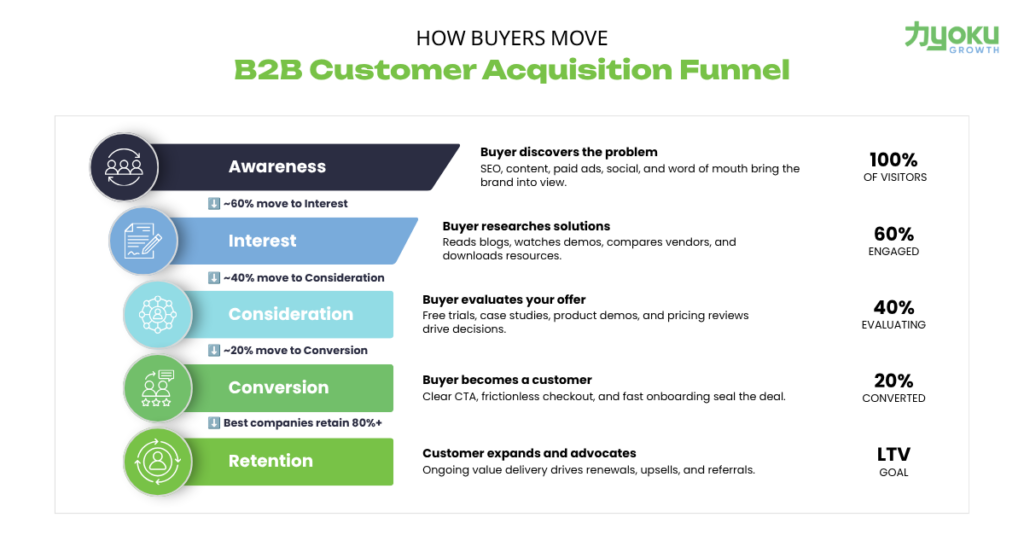
This is why channel selection and messaging cannot be built in isolation. What you say at the awareness stage should pull the buyer toward interest. What you offer at consideration should remove the last reasons not to convert. Each stage has one job, and your strategy should be built around that.
5. Align Sales and Marketing
When marketing generates leads using one message and sales closes using another, trust erodes mid-funnel and deals stall. Both teams need to operate from the same ICP definition, the same core problem statement, and the same value narrative.
6. Measure and Optimise
Activity metrics like open rates and MQL volume are easy to track but often disconnected from revenue. Build your measurement framework around pipeline created, conversion rates at each stage, and customer acquisition cost relative to lifetime value. Then use that data to identify where buyers are dropping off and adjust accordingly.
Go-To-Market Strategy Examples from Successful B2B Companies
Below are some of the most effective b2b saas go-to-market strategy examples and what makes them work.
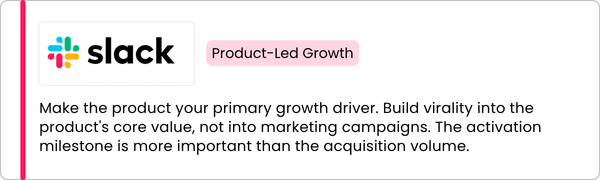
1. Slack: Product Led Growth Done Right
Strategy Type: Product Led Growth
Slack focused on user experience rather than heavy sales. It grew by building a product that made selling unnecessary at the early stage.
Approach:
The freemium model removed the procurement barrier entirely. Teams could adopt Slack without a budget approval or a vendor evaluation. Once one team was using it, adjacent teams followed organically. By the time a company’s IT department or procurement team was involved, Slack already had internal champions across multiple departments.
Why It Worked:
Slack removed barriers to entry. Users experienced value before speaking to sales. This created natural expansion within organisations.
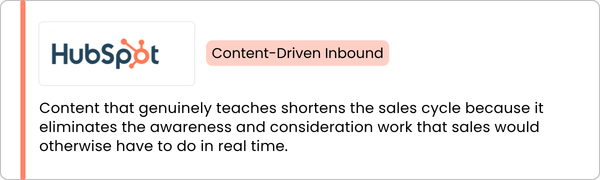
2. HubSpot: Inbound Marketing Engine
Strategy Type: Content Driven Growth
HubSpot built an entire ecosystem around inbound marketing. Their go-to-market strategy was built on a simple thesis: if you help buyers become better at their jobs before asking them to buy anything, they will trust you enough to eventually buy everything.
Approach:
Their investment in educational content, including practical blog posts, downloadable templates, and free tools like Website Grader, wasn’t brand awareness activity. It was a systematic effort to own the search queries that their ICP was already typing. By the time a prospect entered the consideration stage, HubSpot had already answered their most pressing questions multiple times.
Why It Worked:
Each piece of content became a permanent acquisition asset. Companies that invest consistently in blogging are far more likely to see positive returns. This is supported by data showing they are 13 times more likely to achieve ROI, according to the HubSpot marketing statistics report
3. Salesforce: Enterprise Sales Led Strategy
Strategy Type: Sales Led Growth
Salesforce’s early growth was driven by a disciplined, relationship-first sales model designed specifically for enterprise buyers who needed more than a demo before committing to a platform that would reshape their revenue operations.
Approach:
Enterprise deals involve multiple stakeholders, extended evaluation periods, and significant switching costs. Salesforce built a sales organisation that treated each of those realities as an opportunity rather than an obstacle.
Why It Worked:
Dedicated account executives managed relationships over months. Custom onboarding reduced time to value. Ongoing engagement ensured that expansion within existing accounts became a reliable revenue stream.
Enterprise deals require trust and personalisation. Salesforce invested heavily in building relationships.
4. Zoom: Simplicity and Virality
Strategy Type: Hybrid Product Led Growth
Zoom combined product ease with strong word of mouth. Their growth was built on removing friction at every stage.
Approach:
The interface was clean enough that anyone could run a meeting without instructions. The free tier was functional enough that individual users had no reason to look elsewhere. The link-based sharing model meant that every meeting invitation was an introduction to the product for someone who had never used it.
Why It Worked:
Users experienced immediate value. Sharing meetings introduced new users organically.
5. Notion: Community Driven Growth
Strategy Type: Community Led Growth
Notion’s go-to-market strategy was built around a specific insight: their most enthusiastic users didn’t just want to use the product, they wanted to share how they used it. Notion gave them the infrastructure to do that.
Approach:
The template gallery became a community publishing platform. Creators built audiences by sharing their Notion setups. YouTube tutorials, Twitter threads, and Reddit posts produced by users drove more qualified traffic than most paid campaigns could. This wasn’t an accident. Notion made it easy to share workspaces, publish templates publicly, and build a personal brand around productivity systems.
Why It Worked:
Users became advocates. The community amplified growth without heavy marketing spend.
6. Snowflake: Data Platform Expansion Strategy
Strategy Type: Usage Based Growth
Snowflake solved a broken SaaS model: customers commit to contracts before they know the real value, leading to overpaying or underusing. So, they aligned pricing with customer usage.
Approach:
Usage-based pricing removed that friction. Customers started at a level appropriate to their current needs and scaled naturally as their data operations grew. This made the initial decision to adopt Snowflake significantly easier, and it turned every successful use case within an account into a commercial expansion event.
Why It Worked:
The strategy required a strong product to sustain it. If usage-based pricing accelerates growth when the product delivers consistent value, it also accelerates churn when it doesn’t. Snowflake’s focus on enterprise data teams and its deep integration with major cloud providers ensured that customers had strong reasons to increase usage over time.
Each of these companies built their market position differently. But looking at them side by side, the pattern becomes clear: there is no single playbook. The right strategy is always shaped by the product, the buyer, and the stage of growth.
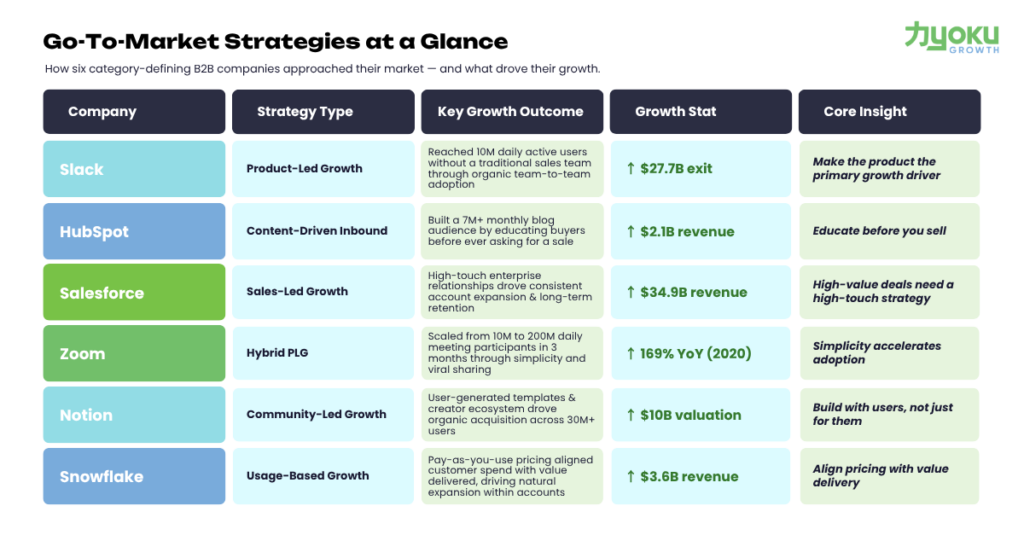
What these examples share is not a common tactic. It is a common discipline: a clearly defined audience, a deliberate channel choice, and consistent execution over time. The following section shows what that looks like when applied from scratch, at the earliest stage of a company.
Example of a Go To Market Strategy for Startups
A startup go to market strategy example often looks different from enterprise approaches.
Scenario: Early Stage SaaS Startup
Goal: Acquire first 100 customers
The first 10 customers are almost always acquired through founder-led sales, personal network, and direct outreach rather than inbound marketing. This is not a limitation to work around but a structural advantage. Founders have credibility, context, and the authority to make real-time product decisions based on what they hear.
Most B2B SaaS startups should hire their first salesperson only after the founder has personally closed the first 10 to 20 customers and the sales process is repeatable. Hiring sales before you have a proven playbook means paying someone to figure out what you should have figured out yourself. The feedback loop is the real asset at this stage.
Execution Plan:
| Stage | Action |
| Awareness | Founder posts on LinkedIn and niche communities |
| Interest | Demo calls and personalised outreach |
| Conversion | Early adopter discounts |
| Retention | Tight feedback loops and rapid feature iterations |
Key Insight:
At the early stage, the founder is the GTM strategy. Every conversation is research. Scale only after the playbook is proven. S
Common Patterns Across Successful Strategies
After analysing multiple go-to-market strategy examples, clear patterns emerge that separate consistently successful launches from ones that plateau.
They focus on a clearly defined segment before trying to scale:
Seed-stage companies tend to win on go-to-market because they’re laser-focused and really clear on product-market fit. That focus creates compounding advantages that bigger companies lose when they go too broad.
They prioritise speed over perfection:
Lengthy go-to-market planning often hurts revenue performance. Companies that move faster with tighter planning cycles tend to outperform those stuck in prolonged prep. A delayed launch doesn’t just mean missed revenue, it means missed learning opportunities.
They align the product experience closely with marketing promises:
Customers expect companies to be clear about their values, and business buyers are far more likely to purchase when they feel understood. Yet many sales teams don’t take the time to truly understand customer goals. When the product doesn’t deliver on what marketing promised, trust erodes.
They double down on what is already working:
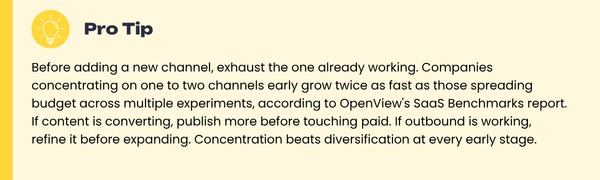
Teams with dedicated sales enablement reach first sales faster, not by doing more, but by doing fewer things with precision. Expanding to new channels before mastering existing ones is a common trap that stalls growth.
They build distribution early:
Strong organic reach is the result of years of consistent investment in content and SEO, not a quick campaign launched alongside the product. Companies that win on distribution treat it as a core product decision from day one, not an afterthought for marketing.
Key Challenges in Go-To-Market Execution
Even with a strong plan, companies face challenges:
Misalignment between teams:
This is the most expensive and least visible problem in GTM execution. An estimated $1 trillion a year is lost due to a lack of sales and marketing coordination in the US alone, and 73% of marketing-generated leads are never contacted by sales. That is not a sales problem or a marketing problem. It is a structural problem with how revenue teams are organised and incentivised.
Understanding these challenges helps in building a more resilient strategy.
Weak or untested positioning:
GTM failures trace back to positioning and messaging gaps. This does not mean the messaging is poorly written. It often means it was never pressure-tested against actual buyer language before launch.
Choosing the wrong channels:
Inbound marketing channels generate 54% of early-stage pipeline but only 23% of closed revenue, according to Salesforce research. Optimising for pipeline volume rather than closed revenue creates a misleading picture of what is actually working.
Poor customer understanding:
Only 29% of B2B customers are actively engaged with the companies they buy from, while 60% are indifferent and 11% are actively disengaged, according to Gallup. This is rarely a product quality problem. It is usually a signal that the wrong customers were acquired in the first place.
Scaling too early:
For products under $5,000 ACV, product-led growth works best because the economics do not support a sales team. For enterprise products above $50,000 ACV, sales-led growth with account-based marketing is standard because buyers expect human interaction and custom negotiations. Scaling the wrong motion for the wrong price point is one of the most common and expensive GTM mistakes.
Internal Linking: Build a Strong Foundation
If you want a clearer understanding of how to structure your approach, the guide on How to Build a Go-To-Market Strategy That Drives Revenue walks through the key elements involved. It covers how to define your audience, choose the right channels, and track what is working, making it useful for turning ideas into practical execution.
Internal Linking: Avoid Costly Mistakes
Execution often fails due to avoidable errors. The article on Common Go-To-Market Strategy Mistakes And How to Fix Them highlights where companies go wrong and how to correct courses. It is especially useful for identifying gaps in your current strategy and improving performance.
How to Apply These Examples to Your Business
Studying examples is useful, but applying them effectively matters more.
Step 1: Choose the Right Growth Approach
Start by identifying the growth model that aligns best with your product and market. This could be product led, sales led, or a hybrid approach, depending on factors like pricing, complexity, and target audience.
Step 2: Narrow Down Your Target Segment
Focus on a specific audience segment rather than trying to appeal to everyone at once. This allows for clearer messaging, stronger positioning, and better initial traction.
Step 3: Experiment with Key Channels
Begin with one or two high potential channels such as content, outbound, or partnerships. Test performance, gather insights, and refine your approach before expanding further.
Step 4: Maintain Consistent Messaging
Ensure that your messaging remains aligned across all touchpoints, from marketing campaigns to sales conversations and product experience. Consistency builds trust and clarity.
Step 5: Continuously Learn and Optimise
Use customer feedback and performance data to make ongoing improvements. A strong go to market strategy evolves over time rather than remaining fixed.
Frequently Asked Questions
What is a go to market strategy example
It is a real world case showing how a company launches and sells its product using defined channels, messaging, and target audience.
What are the types of go to market strategies
The main types include product led, sales led, inbound marketing, and hybrid strategies.
Why do go to market strategies fail
They fail due to poor execution, unclear positioning, and lack of alignment between teams.
How long does it take to build a go to market strategy
It depends on complexity, but most companies take a few weeks to define and continuously refine it over time.
Can startups use the same strategies as enterprises
Not always. Startups need speed and flexibility, while enterprises focus more on scale and structure.
Turn Strategy into Revenue with the Right Execution
Understanding go to market strategy examples is only the first step. The real impact comes from applying the right framework to your business and executing consistently.
Companies implementing advanced sales tools, highly personalised marketing, hybrid sales teams, tailored marketplace strategies, and investment in owned channels are two times more likely to achieve over 10% market share growth, according to McKinsey.
Using a structured approach like the AIDA framework can help guide your strategy:
- Attention: Surface the specific, painful problem your audience already knows they have. Generic pain point language does not convert.
- Interest: Educate with proof, not claims. Sales reps in aligned organisations are 103% more likely to exceed their targets, according to HubSpot’s 2025 State of Sales report, because educational content primes buyers before the sales conversation begins.
- Desire: B2B buyers are more likely to purchase when they see personal value in the decision, and personal value has more than twice the commercial impact of functional business value alone.
- Action: Guide them towards conversion with a strong next step. Remove every obstacle between intent and conversion.
If you are looking to turn your go to market efforts into a predictable revenue engine, Ryoku Growth can help you build and execute a strategy tailored to your business.