

Many B2B companies invest heavily in marketing yet struggle to convert leads into meaningful revenue. Traditional demand generation models often prioritise volume over quality. This results in marketing teams chasing thousands of leads while sales teams focus on only a handful of accounts that actually matter.
The disconnect creates wasted effort and slow revenue growth.
Key Takeaways
• An account based marketing strategy focuses marketing and sales efforts on a defined set of high value accounts instead of broad lead generation.
• B2B companies using ABM often see higher deal sizes, faster sales cycles, and better marketing ROI.
• A successful ABM approach requires strong sales and marketing alignment, precise account targeting, and personalised engagement.
• The process includes identifying ideal accounts, mapping stakeholders, creating personalised campaigns, and measuring account level engagement.
• ABM works best for B2B companies selling complex or high value solutions with longer buying cycles.
Research from ITSMA shows that 87 percent of marketers report higher ROI from account based marketing compared to other marketing strategies. Instead of marketing to everyone, ABM focuses resources on a defined list of high value companies most likely to convert.
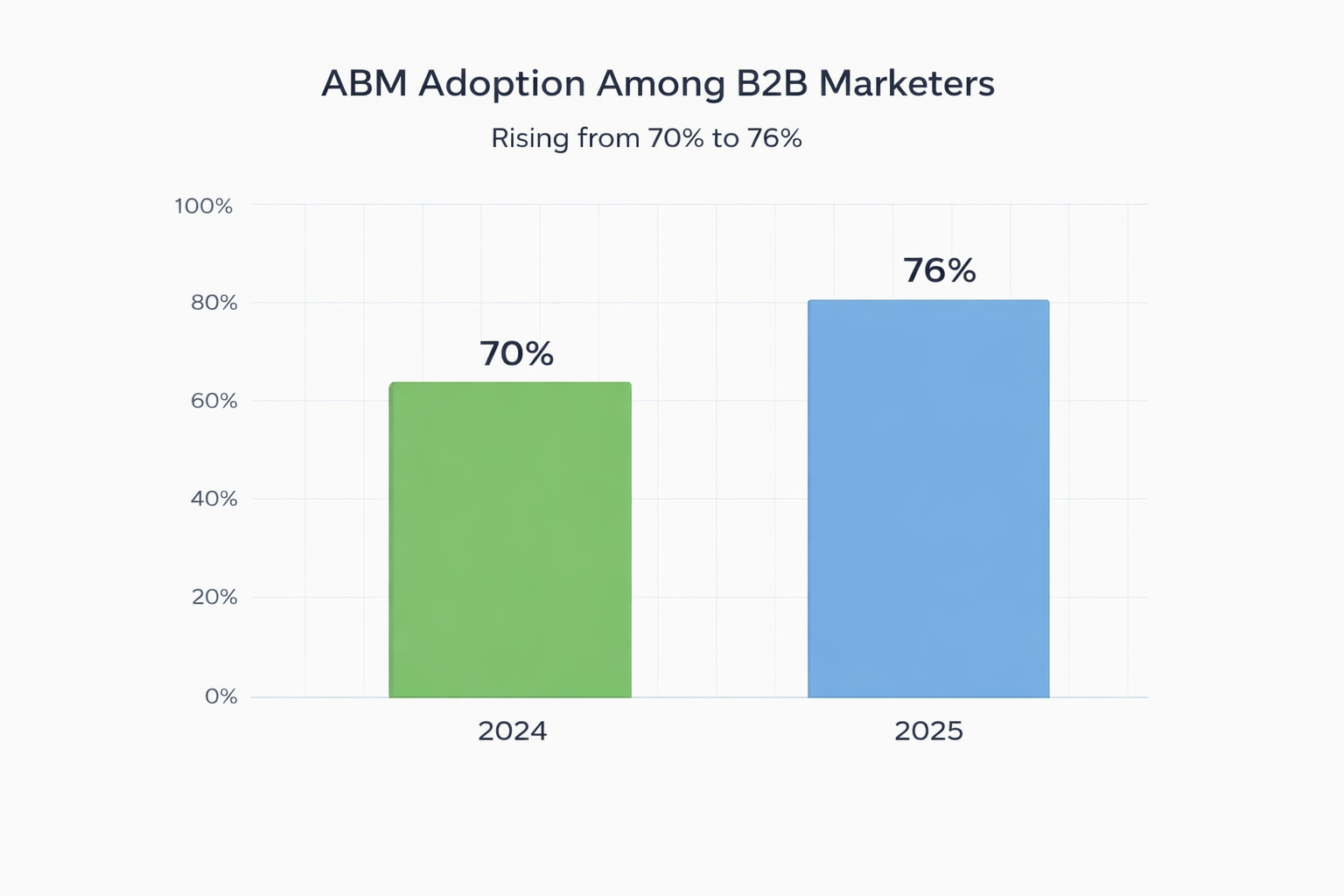
This shift from broad lead generation to targeted engagement is why many B2B organisations are now building a structured account based marketing strategy.
This guide explains how ABM works, why it is effective for B2B growth, and how companies can build and execute successful ABM campaigns.
What Is an Account Based Marketing Strategy
An account based marketing strategy is a focused B2B marketing approach where marketing and sales teams collaborate to target specific high value companies as individual markets.
Instead of generating thousands of leads, the strategy prioritises a carefully selected list of target accounts.
Each account receives tailored messaging, personalised content, and coordinated outreach across multiple channels.
Traditional Marketing vs Account Based Marketing
| Traditional B2B Marketing | Account Based Marketing |
| Focuses on lead volume | Focuses on high value accounts |
| One message for large audiences | Personalised messaging for each account |
| Marketing driven pipeline | Sales and marketing aligned pipeline |
| Lower conversion rates | Higher conversion and deal size |
Because the messaging is personalised and highly relevant, account based marketing for B2B companies typically produces stronger engagement and higher revenue impact.
Why Account Based Marketing Works for B2B Companies
B2B purchasing decisions rarely involve a single decision maker. Enterprise deals often require approval from multiple stakeholders across departments.
A well designed account based marketing strategy addresses this complexity by targeting the entire buying committee within each account.
Key Advantages of ABM
1. Higher Quality Opportunities
Because ABM focuses on high value accounts, companies often see stronger revenue outcomes. In some industry studies, organisations using ABM report up to 171 percent higher average deal size compared with traditional demand generation programs.
2. Stronger Sales and Marketing Alignment
ABM naturally aligns sales and marketing teams because both groups work toward the same list of target accounts.
Shared goals improve collaboration and pipeline visibility.
3. Personalised Buyer Experience
Personalised messaging and tailored campaigns help build trust with decision makers.
Relevant content increases engagement and accelerates decision making.
4. Better Marketing ROI
Instead of spreading budgets across broad campaigns, ABM concentrates investment on fewer accounts with higher revenue potential.
This often results in better conversion rates and larger deals.
5. Clearer Performance Measurement
ABM success is measured at the account level rather than individual leads. This provides a clearer picture of marketing impact on revenue.
Key Components of a Successful Account Based Marketing Strategy
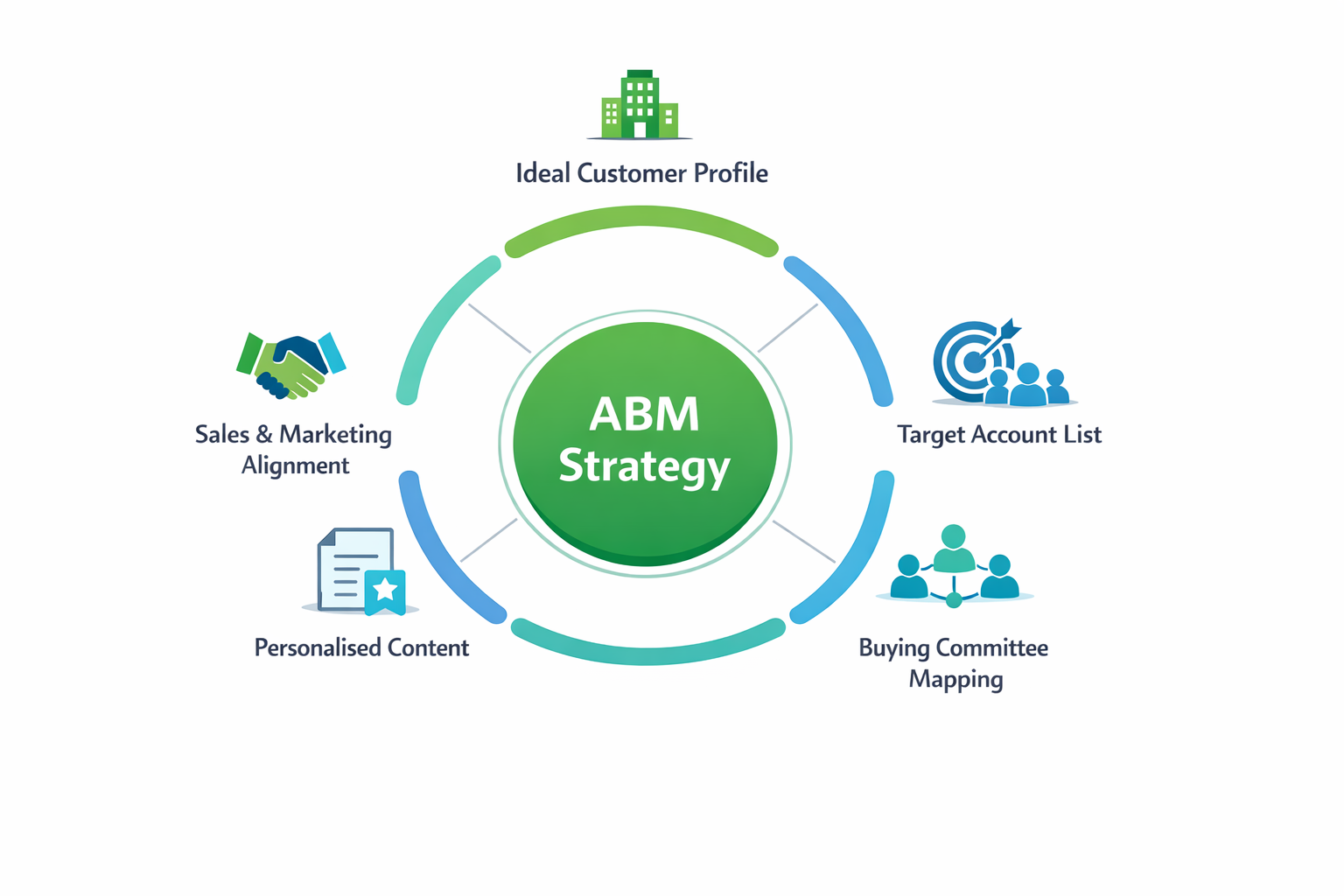
An effective ABM strategy relies on several foundational elements.
Ideal Customer Profile
An Ideal Customer Profile (ICP) defines the type of companies most likely to benefit from a product or service.
Key ICP factors include,
• Industry
• Company size
• Revenue range
• Technology stack
• Geographic market
• Business challenges
Clearly defining the ICP ensures that ABM campaigns focus on accounts with the highest potential value.
Target Account List
Once the ICP is defined, marketing and sales teams identify specific companies that match the profile.
This list often includes
• Strategic enterprise accounts
• High growth companies in target industries
• Existing customers with expansion opportunities
The number of accounts varies depending on the ABM model.
Buying Committee Mapping
Enterprise deals involve multiple stakeholders including
• Decision makers
• Budget owners
• Technical evaluators
• Influencers
Mapping these contacts helps create tailored messaging for each role.
Personalised Content and Messaging
Personalisation is the core of successful ABM campaigns.
Examples include
• Custom landing pages
• Personalised email sequences
• Account specific case studies
• Industry specific reports
• Tailored webinars
The goal is to make each account feel like the marketing effort was designed specifically for them.
Sales and Marketing Collaboration
ABM only works when sales and marketing operate as a single team.
Collaboration includes
• Shared account lists
• Joint campaign planning
• Regular pipeline reviews
• Feedback loops on engagement
Without alignment, ABM campaigns quickly lose effectiveness.
Types of Account Based Marketing Strategies
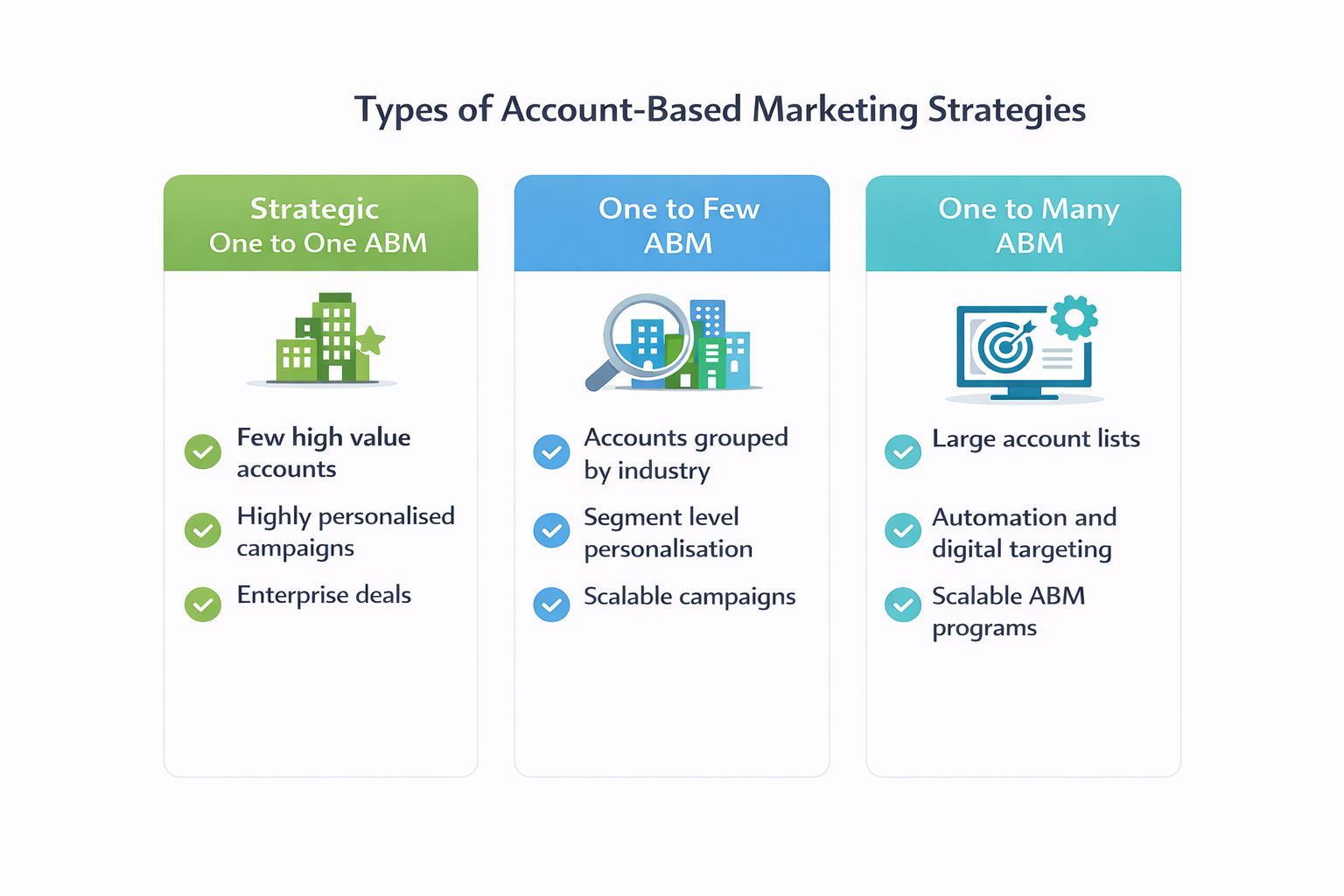
B2B organisations typically use three ABM models depending on account value and resources.
Strategic One to One ABM
This model focuses on a small number of high value accounts.
Each account receives highly personalised campaigns.
Typical tactics include
• Dedicated account research
• Custom content
• Executive level outreach
• Personalised events
This approach is ideal for enterprise deals with large contract values.
One to Few ABM
In this model, accounts are grouped based on shared characteristics such as industry or business challenges.
Marketing campaigns are personalised at the segment level rather than the individual account level.
This allows companies to scale ABM without losing relevance.
One to Many ABM
This is a more scalable approach that uses automation and data platforms to target larger account lists.
Digital advertising, intent data, and marketing automation help deliver relevant messaging at scale.
This model works well for mid market B2B companies.
How to Build an Effective Account Based Marketing Strategy
A successful account based marketing strategy requires a structured process that aligns marketing, sales, and revenue goals. While the exact workflow may vary by organization, most ABM programs follow a similar strategic sequence.
1. Define Your Ideal Customer Profile
Start by identifying the type of companies most likely to benefit from your product or service. An Ideal Customer Profile typically considers industry, company size, revenue range, technology stack, and business challenges.
This step ensures ABM campaigns focus on accounts with the highest long-term value.
2. Identify High Value Target Accounts
Once the ICP is defined, marketing and sales teams collaborate to create a list of strategic accounts that match this profile.
These accounts often include:
• Companies with strong purchase intent
• Organizations evaluating similar solutions
• Existing customers with expansion potential
3. Map Buying Groups and Stakeholders
Enterprise purchasing decisions involve multiple stakeholders. Mapping the buying group helps teams understand decision makers, influencers, and technical evaluators within each account.
This insight allows messaging to address the specific priorities of each role.
4. Launch Personalized ABM Campaigns
With target accounts and stakeholders identified, teams can execute coordinated ABM campaigns across multiple channels such as email, LinkedIn advertising, account specific content, and direct sales outreach.
The goal is consistent engagement across the entire buying committee.
Learn the Full ABM Execution Framework
While these steps provide a strategic overview, executing ABM effectively requires a clear operational framework that connects targeting, messaging, campaign execution, and performance measurement.
The detailed guide Step by Step Account Based Marketing Framework for B2B Growth explains how to implement ABM programs with a repeatable structure that supports long term pipeline growth.
Metrics That Matter in Account Based Marketing
Measuring the right metrics is essential for improving ABM performance.
| Metric | Why It Matters |
| Account Engagement | Shows how target accounts interact with content |
| Pipeline Value | Measures potential revenue from ABM accounts |
| Deal Velocity | Tracks how quickly deals move through the pipeline |
| Average Deal Size | Indicates revenue impact of ABM |
| Win Rate | Measures conversion success |
Tracking these metrics helps companies refine their account based marketing strategies over time.
Focusing on high value accounts also improves pipeline quality. Industry research suggests ABM programs generate 10–30 percent more qualified opportunities than traditional inbound marketing campaigns.
Common Challenges in ABM Implementation
While ABM offers significant benefits, companies often encounter several challenges.
Lack of Sales and Marketing Alignment
Without strong collaboration between teams, ABM campaigns lose coordination and impact.
Poor Account Selection
Targeting the wrong accounts leads to wasted effort and low conversion rates.
Limited Personalisation
True ABM requires meaningful personalisation. Generic campaigns rarely deliver strong results.
Data and Technology Gaps
Successful ABM often depends on integrated systems such as CRM platforms, marketing automation tools, and intent data platforms.
When Should Companies Work With an ABM Agency
Building a full ABM program internally can be complex. Some companies choose to partner with a specialised account based marketing strategy agency to accelerate results.
An experienced agency helps with
• Ideal customer profile development
• Target account research
• Personalised campaign creation
• ABM technology setup
• Performance measurement
Some B2B companies eventually reach a point where internal teams lack the resources or experience required to scale ABM effectively.
The guide When Should You Hire an Account Based Marketing Agency? explains the signs that indicate when external expertise can help accelerate results.
Best Practices for Successful ABM Campaigns
Companies that succeed with ABM consistently follow several best practices.
Focus on Fewer High Value Accounts
Quality matters more than quantity.
Targeting a smaller number of high value accounts often produces stronger results.
Invest in Deep Account Research
Understanding each target company’s priorities, challenges, and organisational structure improves campaign relevance.
Personalise Across Multiple Channels
Successful ABM campaigns combine multiple channels such as
• LinkedIn outreach
• Web personalisation
• Direct sales outreach
• Virtual events
Create Content for Each Buying Role
Different stakeholders have different priorities.
Tailor messaging for
• Executives focused on ROI
• Technical evaluators focused on product capabilities
• Procurement teams focused on cost efficiency
Continuously Optimise Campaigns
ABM is an ongoing process.
Regularly review engagement data and adjust campaigns to improve performance.
Frequently Asked Questions About Account Based Marketing Strategy
What is an account based marketing strategy?
An account based marketing strategy is a B2B marketing approach that focuses marketing and sales efforts on a defined set of high value accounts rather than broad lead generation.
Is account based marketing only for enterprise companies?
No. While ABM is common in enterprise sales, mid market B2B companies can also benefit from it by targeting strategic accounts within their industry.
How long does it take to see results from ABM?
ABM is a long term strategy. Many companies begin seeing measurable engagement improvements within three to six months, while revenue impact may take longer depending on sales cycles.
What tools support account based marketing?
Common tools include
• CRM platforms
• Marketing automation systems
• Intent data platforms
• Account intelligence tools
• Advertising platforms that support account targeting
How many accounts should be targeted in ABM?
The number depends on the company’s resources and deal size. Strategic ABM programs may focus on 10 to 50 accounts, while scalable programs may target hundreds.
Build a High Impact Account Based Marketing Strategy With Ryoku Growth
An effective account based marketing strategy can transform how B2B companies generate revenue. Instead of pursuing thousands of unqualified leads, organisations focus on the accounts most likely to become long term customers.
This targeted approach improves sales efficiency, strengthens relationships with decision makers, and increases marketing ROI.
However, building and executing ABM programs requires expertise in account research, personalisation, campaign orchestration, and measurement.
At Ryoku Growth, specialised B2B marketing strategies help companies design and implement scalable ABM programs that generate meaningful pipeline and revenue growth.
If your organisation is exploring ABM or looking to improve existing campaigns, a structured strategy and experienced execution partner can make the difference between isolated experiments and sustainable growth.